Website Redesign Cost in 2026: What You Actually Own
The price at the bottom of a redesign proposal is the least useful number in it. We have watched a $9,000 quote leave a business worse off than a $60,000 one, and we have watched it run the other direction just as often. Website redesign cost only starts to mean something once you know what transfers to you at the end, because a site you cannot move, cannot edit, and cannot hand to a different team is a rental with a very large deposit.
So price the work, and price the exit while you are at it. Here is what redesigns actually run in 2026, how to read the line items inside a quote, and what should be sitting in accounts with your name on them the day the thing goes live.
What a Website Redesign Cost Looks Like in 2026
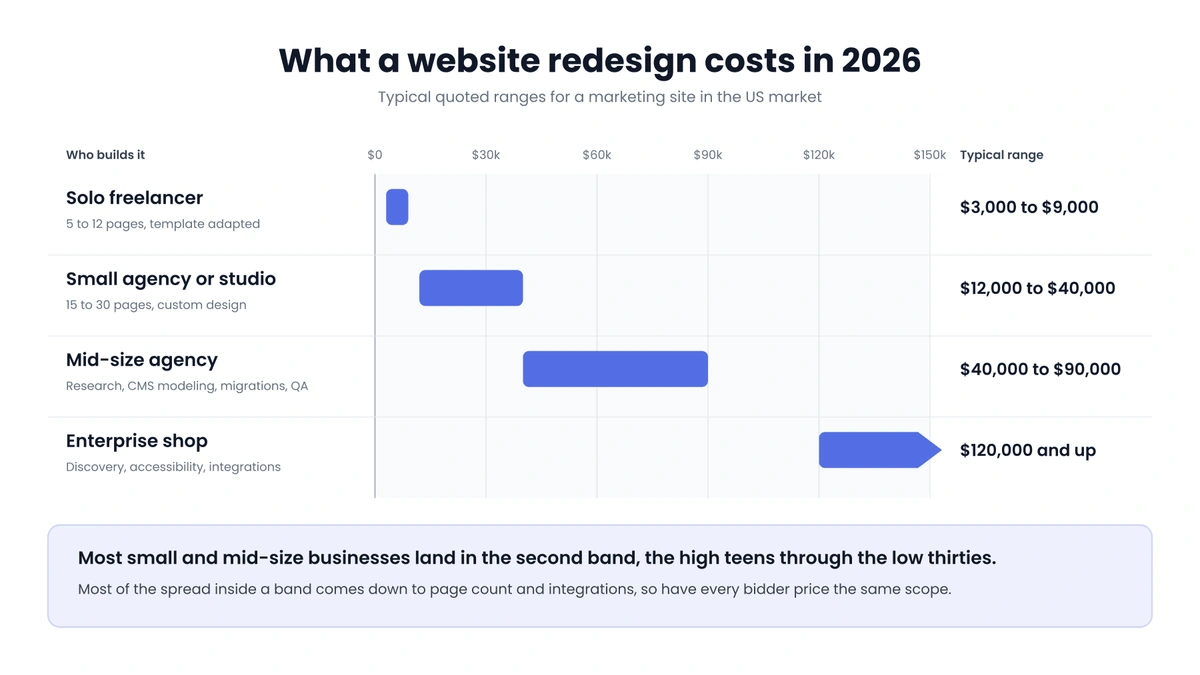
These are the bands we see quoted and paid in the US market right now, for a marketing site rather than an ecommerce catalog or a web app.
| Who builds it | Typical range | What you usually get |
|---|---|---|
| Solo freelancer | $3,000 to $9,000 | 5 to 12 pages, a template adapted to your brand, your content poured in |
| Small agency or studio | $12,000 to $40,000 | 15 to 30 pages, custom design, light strategy, basic integrations |
| Mid-size agency | $40,000 to $90,000 | Research, a custom design system, CMS modeling, migrations, QA |
| Enterprise shop | $120,000 and up | Multi-stakeholder discovery, accessibility compliance, complex integrations |
Most of the spread inside each band comes down to page count and integrations. A 25-page site with a blog, a careers feed, and one HubSpot form is a completely different job from a 25-page site with a location finder, a gated resource library, and a Salesforce handoff, so ask any agency to price those two scenarios separately. You will learn more about how they estimate from that one exercise than any case study will tell you.
The average website redesign cost for a small or mid-size business lands in that second row, call it the high teens through the low thirties. If you are also weighing ongoing help alongside the build, our 2026 agency pricing guide breaks down what monthly retainers run in the same market.
How to Read the Allocation Inside a Quote
How a website redesign cost gets distributed across phases tells you more than the total does. On a healthy $35,000 project the split usually runs discovery and strategy at 10 to 15 percent, design at 25 to 30, build at 30 to 35, content and migration at 10 to 15, and QA plus launch at around 10.
Compare that to what is in front of you. If a quote is 60 percent design and 15 percent build, you are buying pictures of a website and somebody else will eventually get paid to make them real. If discovery eats 40 percent, you are funding a research report that happens to ship with a website attached. Neither is fraud, and both are common, but you should know which one you are signing.
Ask for the numbers by phase rather than as a single blended figure. A vendor who can produce that breakdown in an hour has estimated this work before, and a vendor who stalls on it is guessing. That single request has saved more of our clients more money than any negotiation tactic we know.
The Website Redesign Cost Nobody Itemizes
The build number is one payment. The platform decision sitting underneath it is a payment you make every month for as long as the site exists, and it almost never appears on the proposal.
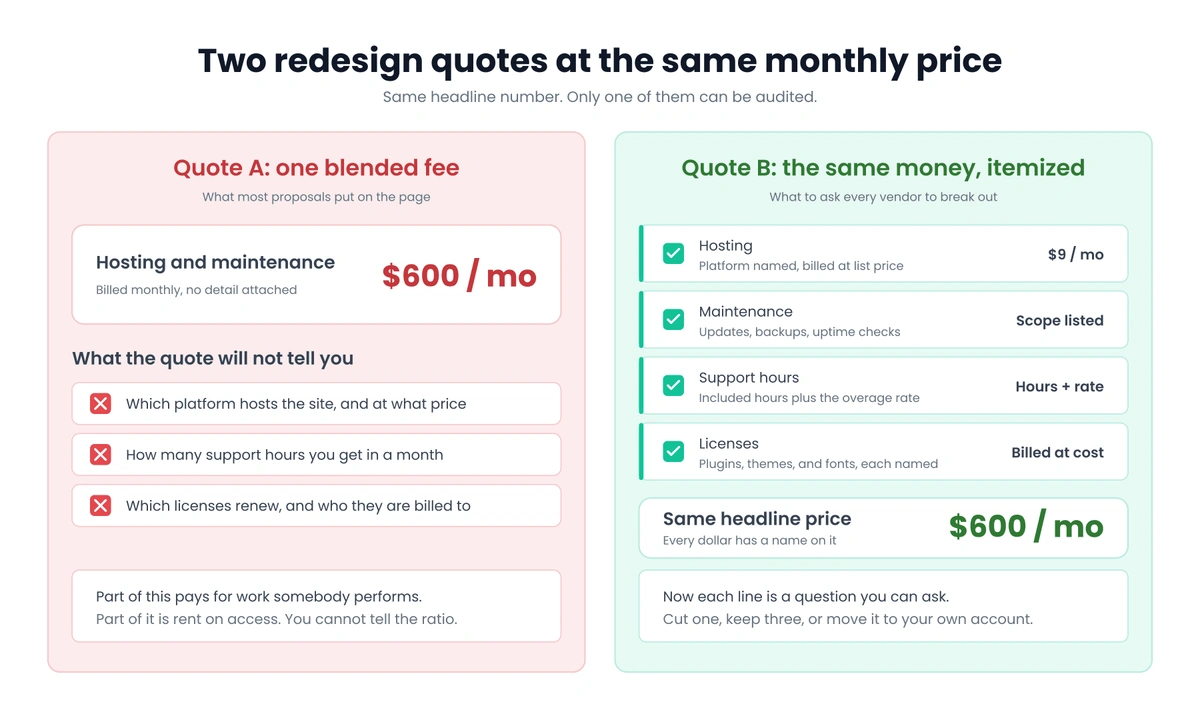
A hosted builder charges per site and often per seat, so every marketer you add to the account raises the bill. A WordPress build with a premium page builder, a forms plugin, a caching plugin, and a security subscription can carry several hundred to a couple thousand dollars a year in license renewals before anybody writes a single word of copy. Then there is the care plan, usually somewhere between $150 and $1,500 a month, and that one line is doing double duty. Part of it pays for maintenance somebody actually performs. Part of it is rent on access to your own site.
Make them split it out every time, because the underlying hosting math is public. Netlify’s free tier costs $0 and its first paid tier is $9 a month, and Cloudflare Pages states plainly that requests to static assets are free and unlimited on both free and paid plans. When a $600 monthly “hosting and maintenance” fee shows up on a marketing site, nearly all of it is labor or rent, and you are entitled to know the ratio before you sign.
Run it over five years and the ranking flips. A $14,000 build on a $600 monthly retainer costs $50,000. A $35,000 build on a $200 retainer costs $47,000 and leaves you holding a repository you can hand to anyone. Cheap up front is usually expensive on a delay, which is the same dynamic we described in our breakdown of vendor lock-in and how to avoid it.
What Should Transfer to You at Handoff
This is the checklist we would run before the final invoice clears. Every item is a yes or a no, and every no is a negotiating point while the contract is still unsigned.
- Source code: a Git repository under your organization on GitHub, GitLab, or Bitbucket, with the agency added as a collaborator rather than the owner. GitHub’s own documentation confirms that when a repository is transferred, issues, pull requests, git history, webhooks, and deploy keys all move with it, so there is no technical reason for an agency to hold the origin. A zip file emailed over at the end is not the same thing.
- Design files: the Figma file living in your team rather than shared to you from theirs. Figma is explicit that transferring ownership only changes who the owner is and does not move the file, which means shared access can evaporate the moment their seat count changes.
- Domain and DNS: the registrar account in your company’s name with billing on your card. Check who runs DNS too, because a domain you own pointed at DNS you cannot edit still leaves you stuck.
- Hosting and deploys: the Netlify, Vercel, or AWS account in your name with the agency invited in, and the same arrangement for build environment variables and API keys.
- CMS content: an export path that produces something usable. Markdown or JSON is ideal, a database dump is acceptable, and a proprietary format only their tool can open is a problem you will inherit.
- Analytics and Search Console: a GA4 property and a Search Console property verified under your email rather than the agency’s shared inbox. Google distinguishes between verified owners, delegated owners, and restricted users, and only an owner can add or remove other people, so being a “user” on your own property is weaker than it sounds.
- Ad and tracking accounts: your Google Ads and Meta Business Manager accounts with the agency granted access, never the reverse.
- Brand assets: layered logo files, fonts licensed in your name, and photography with usage rights spelled out in writing.
None of this is hard at kickoff. It is an afternoon of account invites and one mildly awkward conversation. Untangling it two years later, after a relationship has gone sideways, takes weeks and sometimes a lawyer, which is why we bake the whole list into our website build checklist before a single page gets designed.
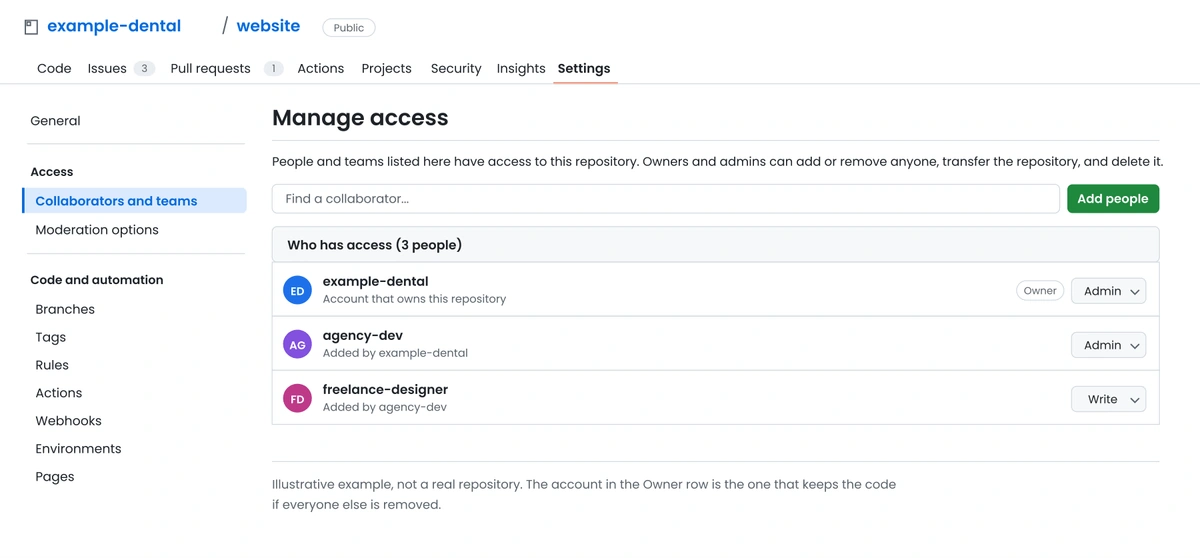
Sitting on two or three redesign quotes and not sure which number is fair? Send them over and we will tell you which line items are real work, which ones are rent on access, and what you would actually own when the site ships. Everything we build belongs to you on day one.
Get a Free Redesign Quote ReviewWhere Owning It Costs You More
We will not pretend any of this is free. Ownership pushes the website redesign cost up at the start, takes longer to deliver, and hands you responsibility you did not have before.
A Squarespace or Wix redesign can be live in two or three weeks for $4,000 to $7,000, and a marketing manager with no technical background can edit it that same afternoon. An Astro or Next.js build in your own repository is more often six to ten weeks and two to four times the money, because custom design and a real content model take longer than picking a template. It also assumes somebody will eventually be able to push to that repository, whether that is a developer on your team, a contractor, or the next agency you hire.
If nobody in your world is ever going to open a pull request, and you genuinely do not care about moving later, a hosted builder is a defensible call. We would rather tell you that than sell you complexity you will never touch. Just go in knowing what comes back out when you leave, because exporting a Squarespace site returns far less than most owners expect and getting off Wix is its own small project.
The test we apply is time horizon. If the site is a two-year placeholder before a real rebuild, optimize for speed and price and do not feel bad about it. If it is meant to compound, with content and rankings and years of analytics history stacking up behind it, the portable build wins on the five-year number nearly every time.
Red Flags in a Redesign Quote
The same warning signs repeat across almost every bad proposal we get asked to review, and each one inflates the real website redesign cost in a way the total never shows:
- The proposal never names the platform, or names it for the first time in the final contract.
- “Proprietary CMS” or “our platform” shows up anywhere. That is a lock-in fee dressed as a feature.
- One blended monthly figure with no split between hosting, maintenance, and support hours.
- No mention of who owns the repository, or a clause saying the code is licensed to you rather than owned by you. Read that section twice, then read it to your attorney.
- Content migration priced as a vague allowance instead of per page or per post. Migration is where these projects go over budget, and it is the line item most likely to get renegotiated in month three.
- No 301 redirect map anywhere in the scope. Google’s own guidance on site moves is to build a full old-to-new URL mapping and use permanent server-side redirects, because 301s do not cause a loss in PageRank. Skipping that step is how a redesign deletes traffic that took years to earn.
One more that is easy to miss: a quote with no measurement plan attached. If nobody is defining what a lead is and where it gets recorded before launch, you will be arguing about attribution six months later. We wrote about how often the reporting itself is the thing that is broken, and a redesign is the cheapest moment to fix it.
If You Are Holding Quotes Right Now
Take whatever proposals are sitting in your inbox and run the handoff checklist against each one. Whichever vendor answers those eight items fastest and most specifically is usually the one to hire, and that is often not the cheapest bid. The website redesign cost that matters is the total across five years, including the exit, and a vendor who is comfortable with that math is telling you something useful about how they plan to keep your business.
If you want a second set of eyes, send the quotes over. We are happy to tell you which number is fair and which line item is rent, even if the answer turns out to be that your current agency is doing fine and you should stay put.
Frequently Asked Questions
What Is the Average Website Redesign Cost?
Most small and mid-size businesses land between $12,000 and $40,000 for a custom 15 to 30 page marketing site in 2026, with the middle of that range being the most common outcome. Anything under $9,000 usually means a template adaptation with your brand applied to it, which is a perfectly fine result as long as that is what you were told you were buying. The number moves most on page count, the number of distinct templates, and how many third-party systems have to talk to each other.
How Much Does It Cost to Redesign a Website With 10 Pages?
Roughly $6,000 to $18,000, depending on how much of the design is custom and whether your content is already written and approved. Page count matters less than the number of distinct layouts, so ten pages sharing three templates costs far less than ten pages that each need their own design and build. Content that needs to be rewritten during the project is the single most common reason a small redesign drifts past its estimate.
Why Does the Cost of a Website Redesign Vary So Much Between Quotes?
Because the quotes are usually for different jobs even when the brief was identical. One includes discovery, custom design, content migration, and a redirect map, while the other is a theme install with your logo dropped in and your existing copy pasted across. Ask every bidder to break out discovery, design, build, content, and QA as separate line items and the range tends to collapse to something you can actually compare.
Do I Really Need to Own the Source Code?
What you need is the ability to leave without starting over, and owning the repository is the cleanest version of that. A documented export path plus control of your domain, hosting, analytics, and Search Console gets you most of the way there if a full code handoff is not on the table. The question worth asking in every sales call is simple: if this relationship ended tomorrow, what could I hand to the next team, and how long would it take them to be productive with it?
Should a Website Redesign Cost Include Ongoing Maintenance?
Maintenance belongs in the conversation, though it should be priced as its own line rather than folded into the build. Ask what the monthly fee covers in specific terms, how many support hours are included, where hosting is billed, and what happens to your site if you cancel. A vendor who can answer those four questions clearly is charging for work, and one who cannot is usually charging for access.
How Long Does a Website Redesign Take?
A template-based rebuild on a hosted platform can go live in two or three weeks, while a custom build with a real content model, migrated content, and a redirect map typically runs six to ten weeks. The variable that stretches timelines most is content, since design and development can move in parallel but nothing launches until the copy is finished and approved. Getting content assignments handed out during discovery rather than after design is the single best way to keep a redesign on schedule.