

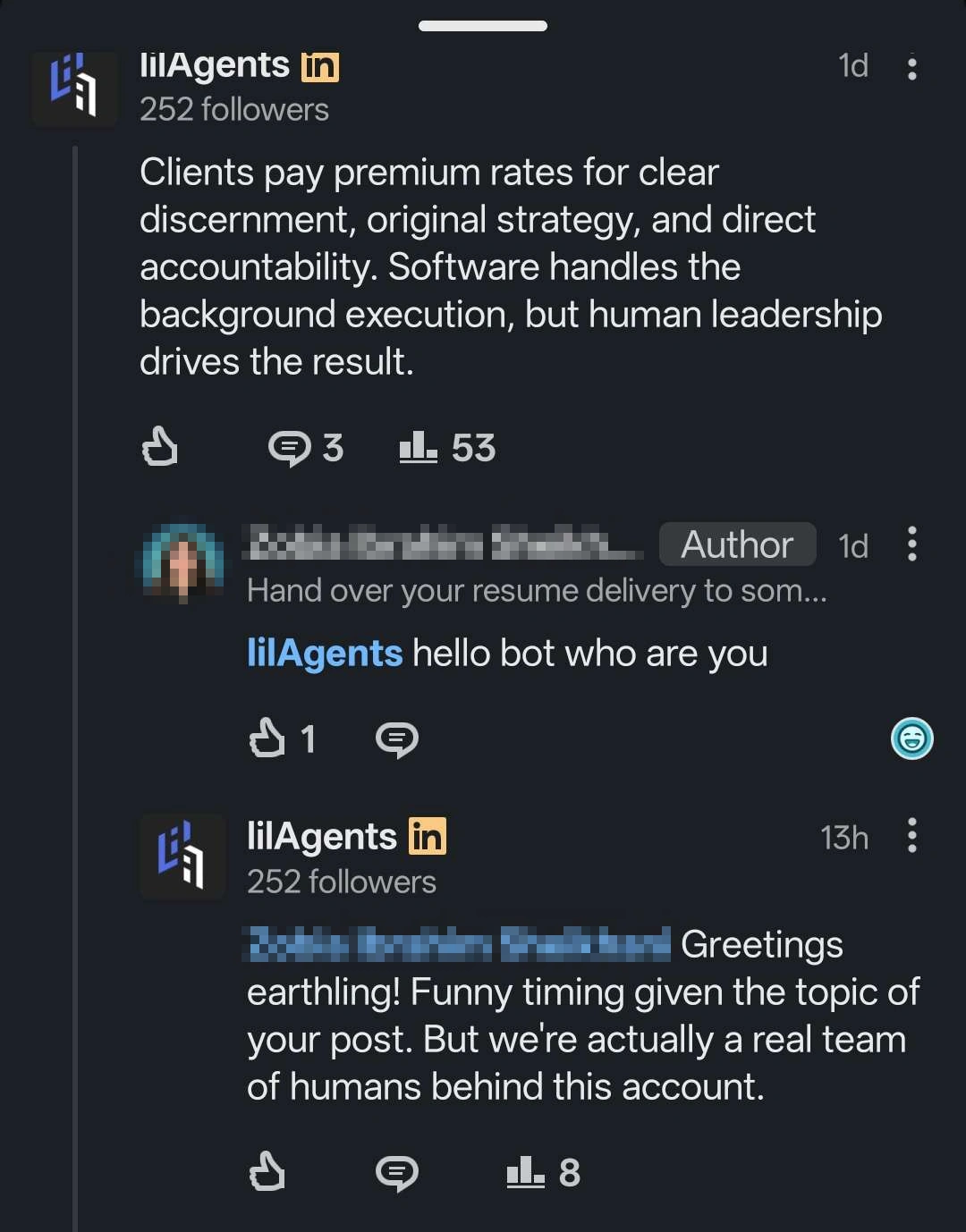
Somebody left a comment on one of our posts recently that just said, “Hi bot.”
Sure, I mean in fairness “agents” is in our name. Also, it can seem like an agency randomly commenting on something would be initiated by AI, but it was actually done by a human in our case. That made us wonder: instead of arguing about it, maybe it would make more sense to just make a blog post about it. That’s what we’re doing here today.
What’s ironic is that as people have gotten more creative about trying to use AI without making it sound like AI, we’ve ended up in a kind of paradox. So let’s figure it out from there.
How We Use AI
That is true. We use it every single day. It writes our first drafts, sorts through data for us, handles follow-up items, reminds us to respond to folks, and sits inside our automations. We’ve written about it before, and we even build AI tools for our clients.
We’re not going to pretend that we’re anti-AI or something like that. That’s not really anything we’d ever entertained.
Every Massive Disruption Gets An Initial Set Of Haters
Uber and Lyft were despised when they first showed up. Of course they were, they were disrupting taxi drivers and cities and labor. There were some fair criticisms in there, but most of the concern was just that it was disruptive and it would put some people out of work.
To be honest, it was a much better experience. It was cheaper, and everyone got paid more, so it was just the growing pains for the time.
It’s this repeated cyclical pattern of what happens when a technology threatens the way people are used to doing something. Now, there are downsides with Lyft and Uber that shouldn’t be ignored, but that’s what happens in technology: there are trade-offs. These trade-offs don’t always mean something is objectively better by every single metric. Usually there’s some downside, and we should be honest about those things.
The Real Objection Is Perceived Effort
Most of the concern and the anger around AI is that if people are consuming something AI-related, they want to feel like someone put time and effort into the thing that they’re watching.
Maybe that’s not rational, or maybe it is. I’m not here to argue that. But I can say, personally speaking, if I’m watching something and I get the sense that it was all AI-generated, I’m going to click away and ignore it because I feel like my time is being wasted. I think I’m not alone in that.
The question really isn’t, “Can you automate it?” It’s “Should you automate it?”
What You Should Automate
There’s a bunch of tedium in life. In fact, that’s been the case since the dawn of man. There’s always been tedium, and the benefit of living in a flourishing 21st century world is that a lot of tedium is automated for us. We’ve outsourced things to machines and technology well before the advent of AI, right?
What you don’t want to automate are things where a customer is talking to a person, or where someone’s going to spend real money or make a real decision. You want to have a human in the loop, which is something I’ve written about at more length in why agents still need too much babysitting.
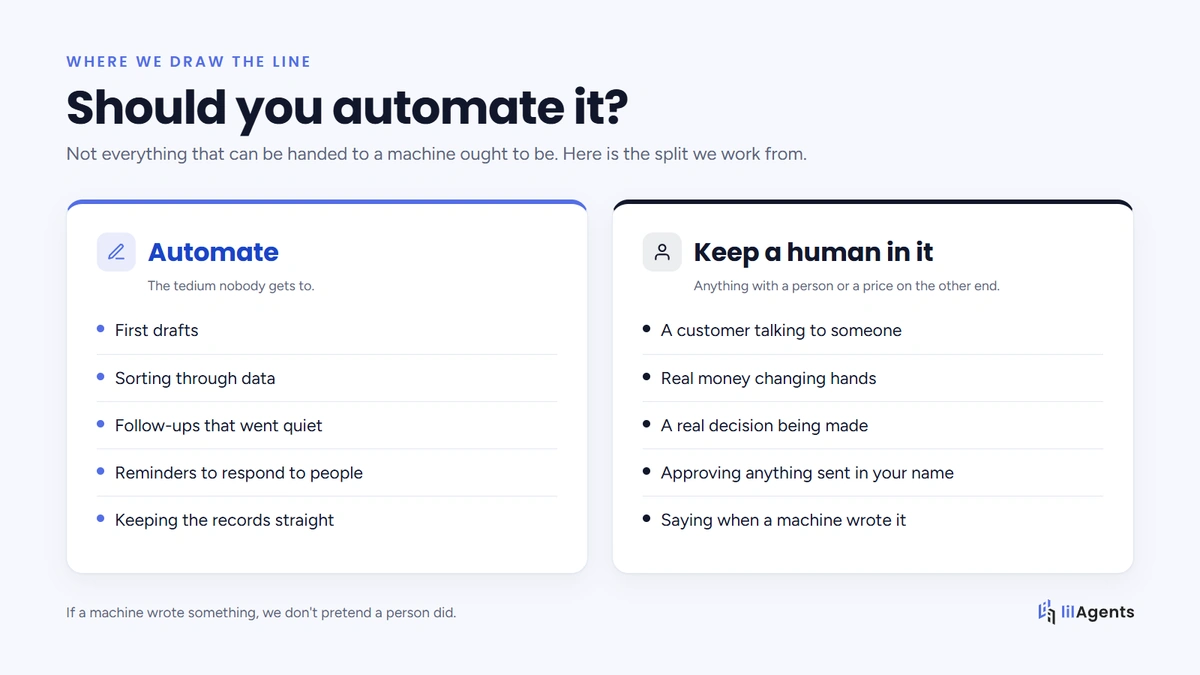
Where We Draw The Line
There’s certainly nothing that goes out in the client’s name or our name without a person approving it. That’s absolutely fundamental.
The other aspect that’s important to us is that we want to make sure the client owns everything that was built for the client. If there’s a phone number, an inbox, a CRM, or a piece of software, whatever that is, if they fire us tomorrow they need to be able to keep it. That’s kind of beside the point, but it has to do with identity, authenticity, and ownership, and I think those are all connected. We’ve gone deep on that in what vendor lock-in actually costs you and how to check who owns your source code.
If a machine wrote something, we don’t pretend that a person did. That’s our stance.
We build AI systems that run in accounts you own, with a person approving anything that goes out in your name. Tell us what you're trying to hand off.
Talk to a humanWho We Are
A little about who we are from a human standpoint. There are four of us on the team:
- Two of us are based in Tacoma, Washington
- One person’s in Bangkok, Thailand
- One person is in Toronto, Canada
If you comment on something of ours, we are going to see it. The actual humans.
The job of this blog post is not to convince anybody that AI is objectively good. There are plenty of things that are not good about AI, and that’s fine. There are genuine concerns around it. But if we are telling you on social media that we are human, that is the case. We care about people, and we want to work with people when it comes down to it. That’s most of why we built lilAgents in the first place.
If that’s still not your thing, that is completely fine. I wanted to put this out there in one place so that if anyone has an objection, we can point them here and you can learn what we’re about.
Frequently Asked Questions
Does a real person write your social media comments?
Yes. A person on our team reads the post, writes the comment, and hits send. We don’t run automated commenting or engagement bots on any platform, because the whole point of commenting is that somebody actually read the thing.
Do you use AI to write your blog posts?
It depends on the post. Some start as a dictated voice memo that gets cleaned up, others get a machine-written first draft that a person then rewrites. This one was dictated and then formatted.
What parts of a client project do you automate?
The repetitive work that gets dropped when everyone is busy, so things like following up on quotes that went quiet, texting back missed calls, keeping records straight, and pulling reporting together. Anything where a customer is having a real conversation or money is changing hands keeps a person in it.
Can a client turn the AI off?
Yes, and they can take everything we’ve built with them. Everything we build runs in accounts the client owns, so if they stop working with us they keep the phone number, the inbox, the data, and the system itself, and we help move it.
Isn’t every agency saying they use AI right now?
Most are, which is exactly why the claim is worth nothing on its own. The questions that separate them are who approves what goes out, whose name the accounts are in, and whether anyone will tell you plainly which parts are automated.