
How to Hire a Generative Engine Optimization Agency
Every new marketing channel gets a land grab, and in generative engine optimization the land is your website. The proposals clients have forwarded us this year, one generative engine optimization agency after another, all have the same shape: the deliverables sound like content, schema, and technical fixes, and then the fine print puts the schema on the vendor’s script, the tracking behind the vendor’s login, and the content under a license that expires when the invoices stop. Most of the tactics in those decks are reasonable, so the trouble sits in the contract rather than the work. This is the exact point in a channel’s life when lock-in gets written in, while everybody is too busy being early to argue about page three.
The buying pressure is real. Google now attaches an AI-generated answer to a meaningful share of searches, running between roughly 6% and 25% of queries over the past year depending on the month and the vertical, according to Semrush’s AI Overviews study. Buyers are also asking ChatGPT and Perplexity the questions they used to type into a search bar. So the demand is genuine, and the supply is a results page where shops that were selling something else eighteen months ago sit next to shops that are excellent at this.
Everything below is a way to tell those apart. Each question you ask a generative engine optimization agency is a version of the same one: when this ends, what do I still have?
What a Generative Engine Optimization Agency Can Actually Change
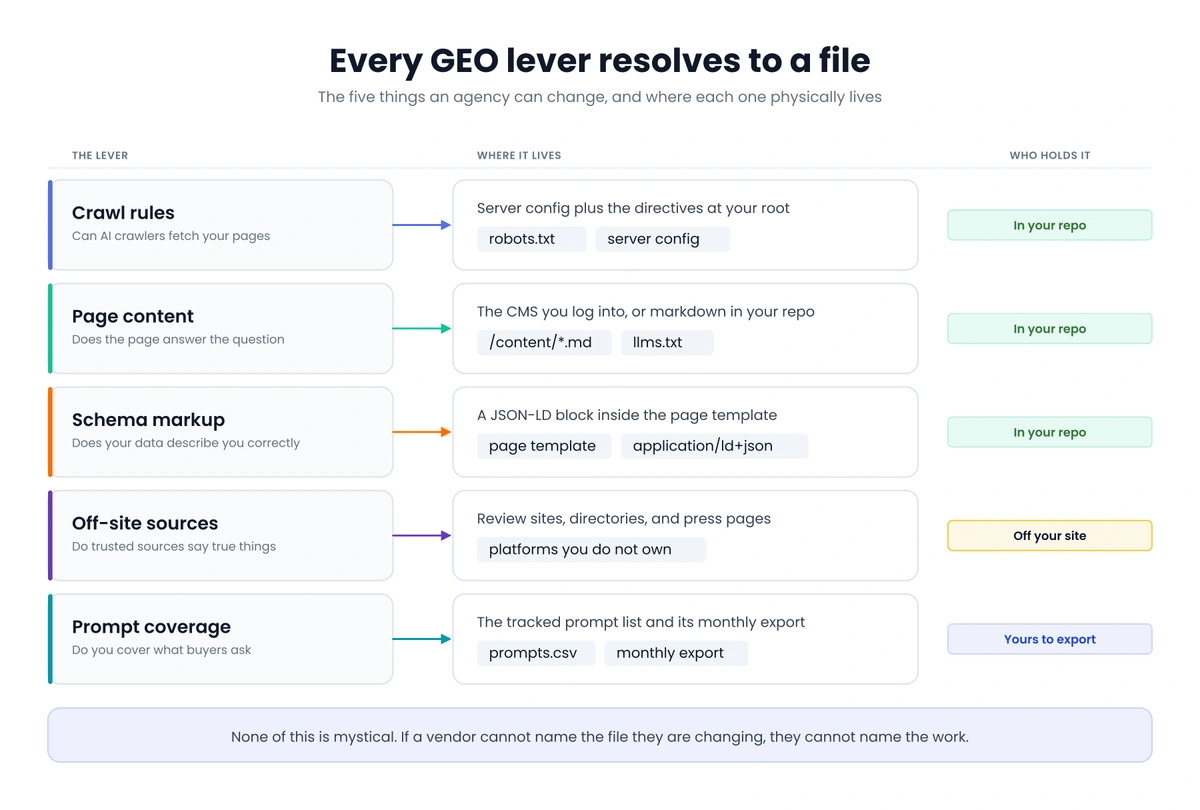
Half of the bad proposals come from a fuzzy idea of what the work even is, so start with scope. There is no ranking dial inside ChatGPT, and what a generative engine optimization agency can genuinely influence is a short list:
- Whether AI crawlers can fetch your pages at all
- Whether a page answers the question directly enough to be worth quoting
- Whether your structured data describes your business accurately
- Whether the third-party sources the models already trust say true things about you
- Whether you have coverage on the specific questions your buyers ask
That is the surface area, and it is backed by more than vendor opinion. The original GEO research paper accepted to KDD 2024 found that content-level changes moved visibility in generative engine responses by as much as 40%, with results varying by domain, which says the levers are real and that nobody gets to promise a number. Everything else in a GEO deck reports on those five items. Our practitioner guide to generative engine optimization walks through how each lever works if you want the mechanics before your first sales call.
Now notice that every item on that list resolves to a file. Crawl rules live in robots.txt and your server config, answers live in your page content, structured data lives in your templates as JSON-LD, and llms.txt sits at your domain root. Those files are either in your repository or inside somebody else’s platform, and which one it is decides what you are left holding when the relationship ends.
The Ownership Questions to Ask a Generative Engine Optimization Agency
Ask these first, and ask them in a way that forces a specific answer instead of a reassurance.
Where Does the Schema Markup Physically Live?
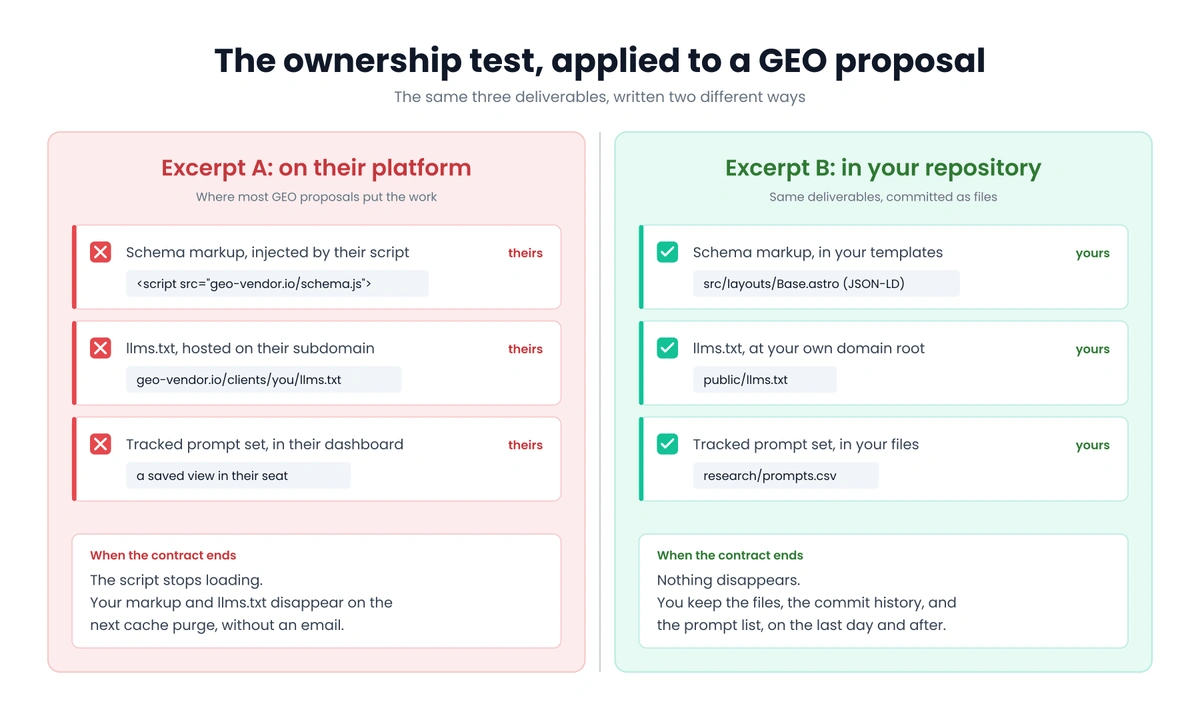
The answer you want is “in your templates, in your repo, committed as JSON-LD,” which is also the format Google recommends for structured data because it is the easiest to maintain at scale. Any version of “our platform injects it” should slow the conversation down, since injection through a tag manager or an edge worker turns your structured data into a rented service. Cancel the contract and your rich results and entity markup disappear on the next cache purge, without so much as an email. If the agency pushes injection because your CMS makes template edits genuinely painful, that is a fair constraint, and the deliverable becomes a documented JSON-LD block you can paste in yourself.
Who Owns the Content, in the Contract, in Writing?
You want an explicit work-for-hire clause or a copyright assignment on delivery. Under US copyright law the party that commissioned a work counts as the author only when the arrangement qualifies, and the Copyright Office spells out the conditions in Circular 30 on works made for hire, so this is a clause your attorney should read rather than skim. “You have a license to use the deliverables” is a different animal, because a license can be revoked. We have watched an agency pull a client’s entire blog archive during a payment dispute, and the client had no legal claim to words they had already paid for.
Do You Deploy Through Our Repository or Your Own?
If a GEO agency is touching your site, the changes should show up as commits in your Git history with readable messages. That gives you an audit trail, a revert path, and proof of what shipped, which doubles as the cheapest defense against paying a retainer through a month where nothing happened. Our website build checklist starts from the same place, with where the code lives rather than what it looks like.
Will You Write Our llms.txt, and Where Will It Live?
It belongs at yourdomain.com/llms.txt as a plain markdown file in your repo, short enough to read and understand in about two minutes. The llms.txt proposal is deliberately simple for that reason, so there is no technical excuse for a vendor hosting it on their own subdomain and pointing at it. If that is where it lives, that file is theirs.
What Credentials Will Exist on the Last Day?
Make the list at kickoff: Search Console, GA4, the CMS admin, DNS, the CDN, the hosting account, any AI visibility tool. Each one should be owned by an account at your domain with the agency added as a user, never the other way around. Getting that backwards is how a two week transition turns into a six week one, and it is the most common form of vendor lock-in we untangle for new clients.
How a Generative Engine Optimization Agency Should Measure Its Work
Most GEO reporting is a poll dressed up as a metric, so the baseline is the first thing to interrogate.
Ask exactly how it was measured, and expect four specifics back: the prompt list, which models, how many runs per prompt, and the dates. Model outputs are not reproducible run to run, and the engineering write-up on defeating nondeterminism in LLM inference traces the cause largely to batch-size variation on the serving side, meaning the number of strangers hitting the same endpoint at that moment changes your answer. Run the same prompt ten times and you will see a meaningfully different set of brands named across those runs. A single-run baseline is noise, and any percentage built on it will “improve” in month two for reasons nobody controlled.
Exports come next, and since everyone can export, the useful question is whether a monthly CSV or API pull lands somewhere you own without anyone having to remember to ask for it. Set that up and the vendor’s dashboard becomes a convenience you can walk away from. Skip it and your whole history of AI search visibility lives in an account you will eventually stop paying for.
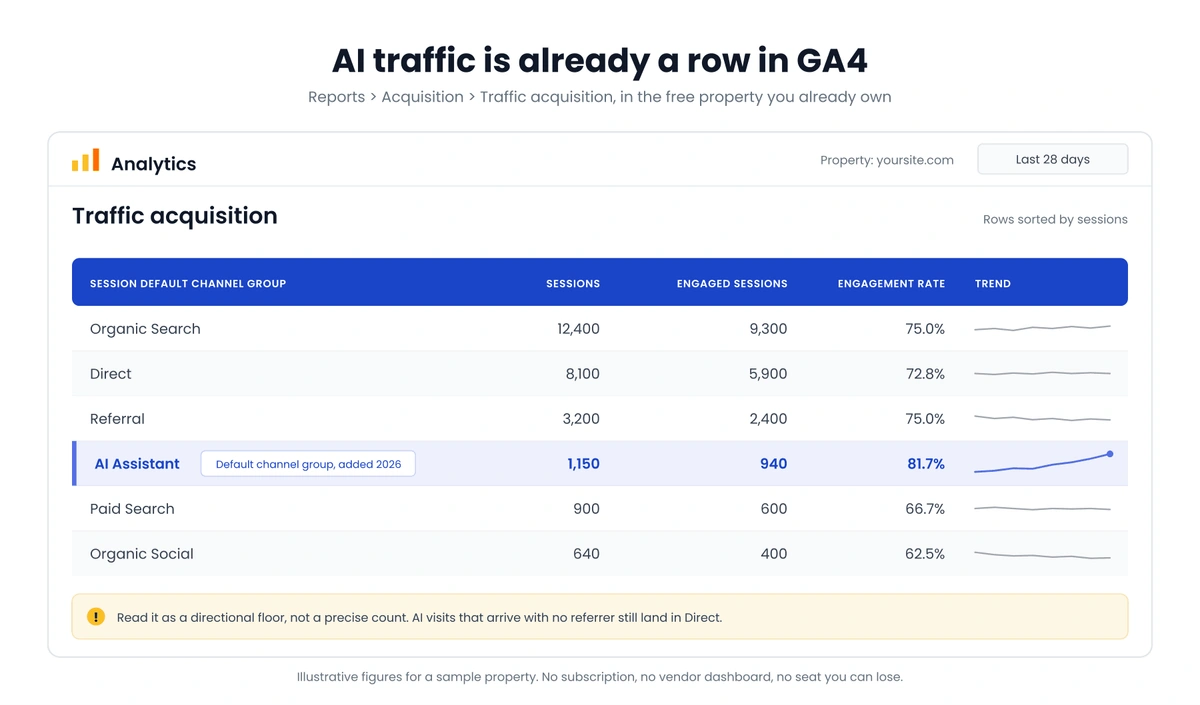
Attribution is where we listen hardest for honesty. Some ChatGPT clicks arrive tagged with utm_source=chatgpt.com, plenty arrive with no referrer at all, and Google only added a native AI Assistant channel to GA4’s default channel groups in 2026, which still depends on a referrer being sent in the first place. Every AI traffic number you see is a directional floor rather than a precise count, so a generative engine optimization agency reporting a clean referral figure without ever mentioning that gap has either not looked closely or is rounding in its own favor.
The last question is small and gets forgotten until it matters: if you leave, who keeps the tracked prompt set? That list is the real asset in AI search visibility work, because it encodes what your buyers actually ask, and you should hold a copy of it rather than a saved view inside somebody else’s seat of a tool.
Where Owning It Costs More
We would rather say this here than have you find it out in month two, because the owned path starts slower and usually costs more up front. A managed GEO platform can have schema live across a 400 page site in an afternoon, since injection does not care about your templates. Doing it in your codebase means a developer, a staging environment, and a deploy, and on a WordPress site with a page builder in the mix that can be a couple of weeks and a few thousand dollars before anything shows up in a report.
Measurement works the same way. A subscription hands you a chart on day one, while building your own sampling harness against an API costs a couple of days of engineering plus a standing maintenance tax. If you have no technical capacity in house, paying for the platform and pulling the exports every month is a defensible call, and it beats flying blind on brand visibility in AI search for another year.
So the line we hold is narrower than “never rent anything.” Rent the convenience and own the artifacts. Once a monthly fee is the only reason your markup still exists, you are paying rent on your own website, which is the same lock-in the last generation of agencies built, wearing newer vocabulary.
What the Retainer Should Buy
Pricing for a generative engine optimization agency is still unsettled, and the proposals we have reviewed run from roughly $1,500 a month into five figures. The number matters less than the itemization, so ask for the retainer to be broken into content, technical changes, and reporting, then look at the ratio. If reporting is more than about a quarter of the total, you are buying a dashboard with some work attached. Our 2026 agency pricing guide covers how those ranges compare to traditional retainers, and what a GEO engagement actually includes breaks the deliverables down line by line.
Sequencing matters too, because the first month of a good engagement is mostly audit and fixes. If a proposal has you shipping twelve articles in week one before anyone has checked whether AI crawlers can reach your existing pages, that is backwards. OpenAI’s crawler documentation is public and specific about which user agents do what, and OAI-SearchBot governs whether you can appear in ChatGPT’s search answers at all, so a shop that has not read your robots.txt against it is optimizing content nobody will fetch.
Red Flags That End the Conversation
- Guaranteed placements, or any version of “we will get you ranked in ChatGPT.” Nobody can promise output from a system they do not control.
- A proprietary visibility score with no disclosed methodology. If you cannot reconstruct the number, it is a marketing asset wearing the costume of a measurement.
- A retainer whose only recurring deliverable is a report, which means the monthly fee buys observation rather than work.
- A vendor who cannot tell you which specific files on your site will change. Anyone who cannot answer that should not be editing your files.
- A contract with an auto-renew clause and a 60 or 90 day notice window on a channel this new. Twelve months is a long time to be wrong about a vendor.
Weighing a GEO proposal right now? Send it over and we will read it with you, flag the clauses that end up renting you your own website, and tell you plainly when the vendor in front of you is a good fit. No pitch, no retainer required.
Have Us Review Your GEO ProposalIf You Are Mid-Decision
Bring the proposal you are weighing and go down this list with the agency on the call. A good generative engine optimization agency answers every question without getting defensive, because a shop that already works this way finds these questions easy and slightly flattering. The bad answers announce themselves, usually as a pivot to how sophisticated the platform is.
The broader version of this exercise lives in our complete guide to choosing a marketing agency. The questions change slightly by channel, and the underlying test never does: at the end of the contract, do you still own the thing you paid to build?
Frequently Asked Questions
What does a generative engine optimization agency actually do?
The work covers whether AI crawlers can reach your pages, whether those pages answer questions directly enough to be quoted, whether your structured data is accurate, whether the third-party sources models already trust describe you correctly, and whether you have content covering the specific questions your buyers ask. Everything else in a GEO proposal is measurement or reporting layered on top of those five things. An agency selling you visibility with no changes to your actual site is selling you a thermometer.
How much should a generative engine optimization agency cost?
The proposals we have reviewed run from about $1,500 a month into five figures, and the total tells you far less than the breakdown does. Ask for the retainer itemized into content, technical work, and reporting, then check the ratio between them. If reporting eats more than roughly a quarter of the fee, you are paying mostly for a dashboard, and if the agency cannot itemize at all, that is its own answer.
How do I improve brand visibility in AI search without hiring anyone?
Start with the pages AI crawlers already fetch most, which your server or CDN logs will tell you for free. Answer the question in the first two sentences of a page, keep your facts in text instead of trapped inside images, make sure your schema is accurate, and work on getting the specific claims you want repeated onto the sources models already cite. That gets you a surprising distance before anyone needs to be hired.
Should the contract say anything specific about AI search?
Yes, and the clauses worth adding are boring ones. Get work-for-hire or assignment language on all content, a written statement that schema and llms.txt ship into your repository rather than an injected script, a named list of accounts that stay under your domain, and a monthly export of any visibility data to a location you control. None of that is adversarial, and a generative engine optimization agency that already works this way will sign it without a negotiation.
How long before a generative engine optimization agency shows results?
Plan on the first month being audit and fixes rather than published output, since shipping content before confirming AI crawlers can reach your existing pages wastes the budget. After that, meaningful movement in how often you get cited usually takes a few months of consistent work, and any baseline built on a single run of prompts is too noisy to read a trend from. Ask for the measurement method up front so month three is not an argument about whether anything changed.