AI SEO Services: What They Are and How to Pick an Agency
Your next customer might not Google you at all. They might ask ChatGPT for “the best meal prep service near San Jose” or ask Google’s AI Mode whether your firm is worth hiring, and the answer they get back depends on signals most websites were never built to send. That gap is exactly what AI SEO services exist to close.
The shift is measurable. A 2026 study from Eight Oh Two found that 37% of consumers now start their searches with AI tools instead of Google or Bing, and 60% say AI gives them clearer answers than a results page. Pew Research puts ChatGPT usage at 34% of US adults, roughly double what it was in 2023, and 58% of adults under 30. Meanwhile, Semrush’s AI Overviews study found Google now attaches an AI-generated answer to roughly 16% of all queries, and that share peaked near 25% mid-2025.
So the question stops being whether AI search matters and becomes a more practical one: what do AI SEO services actually include, what should they cost, and how do you tell a real AI SEO agency from one that just added “AI” to its homepage last quarter? We run this work for clients every week. Here’s the honest version.
What Are AI SEO Services?
The term gets used two different ways, and a surprising number of agencies blur them on purpose, so let’s separate them.
Meaning one: using AI to do SEO faster. Keyword research, content briefs, technical audits, and internal linking run with AI assistance. This is how the work gets done efficiently in 2026, and any competent agency operates this way. It’s table stakes, and it shouldn’t carry a premium price tag.
Meaning two: optimizing your business to be found BY AI. This is the newer discipline, sometimes called generative engine optimization (GEO) or answer engine optimization (AEO). The goal is getting your business cited when ChatGPT, Perplexity, Claude, or Google’s AI Overviews answer a question your customer asked. Different surfaces, different rules, different work.
Good AI SEO services cover both, because they reinforce each other. The same clean structure that helps Google’s crawler also helps an AI engine quote you accurately, and content that earns citations in AI answers tends to rank well in traditional results too. You don’t have to pick a side, and the Eight Oh Two data shows why: 85% of people who get an answer from AI still verify it through a traditional search. Your business needs to show up in both places, telling the same story.
What an AI SEO Agency Actually Does
Strip away the buzzwords and the deliverables look like this:
Technical readability for machines. AI engines lean on structure even harder than traditional crawlers do. That means clean semantic HTML, structured data (schema markup) that spells out what your business is and does, fast pages, and crawl access for the AI bots that matter. It also increasingly means agent-facing files like llms.txt that hand AI systems a map of your site. We researched how the Fortune 500 scores on AI agent readiness and found that not one of the five hundred largest American companies passed more than five of eight basic checks. The bar is on the floor, which is good news for a small business willing to clear it.
Content engineered to be cited. AI engines quote sources that answer questions directly, make claims that stand on their own, and back them with specifics. An AI SEO agency restructures your content around the questions your customers actually ask, with answers an engine can lift cleanly. AI engines skip vague brand copy and cite clear, sourced, specific claims.
Entity and reputation signals. AI engines decide what to say about you by reading everything: your site, your reviews, your directory listings, third-party mentions. The work includes making sure your business entity is consistent and unambiguous everywhere it appears, so the engine doesn’t confuse you with someone else or, worse, say nothing about you at all.
Measurement that matches the new reality. Rankings still matter, but AI SEO adds new questions: which AI engines cite you, for which queries, and what they say. Tracking tools for this are young, so an honest agency tells you what’s measurable today and what’s still inference.
Do AI SEO Services Actually Work?
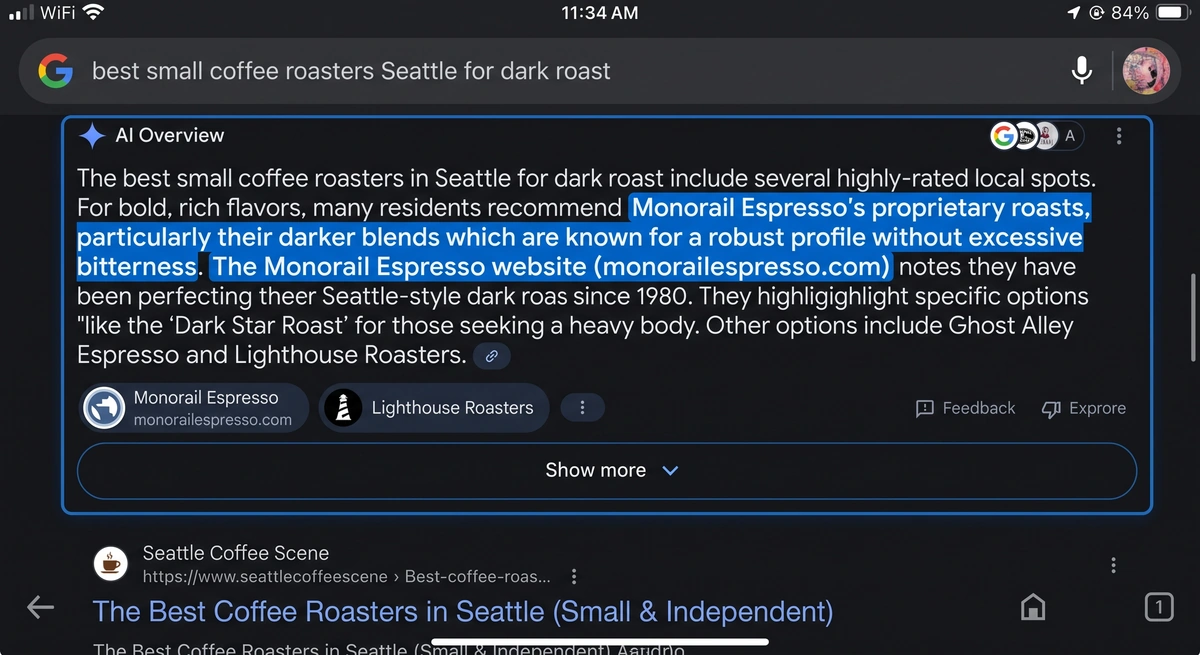
Fair question, since the discipline is young and full of overpromises. Here’s our own receipt: this month, one of our posts became the #1 cited source in Google’s AI Overview for a competitive agency-evaluation query we track. Our domain is young and we outrank sites with far more authority on that answer, because the post is structured the way AI engines prefer: a direct question, a direct answer, specific claims an engine can quote.
That’s the upside. Now the caveat, and it matters more than the upside. Any agency that guarantees you’ll “rank #1 in ChatGPT” is selling control that doesn’t exist. We tell prospects this even when it costs us the deal: you can influence what AI engines cite through authority, structured data, and better content. You cannot dictate it, and the practitioners who actually do this work know that. If a pitch promises guaranteed AI placement or a specific number of AI-sourced leads, that’s the tell to walk away.
What you can reasonably expect from legitimate AI SEO services: your site becomes technically readable to AI systems within weeks, your content starts earning citations on low-competition queries within a few months, and your visibility compounds from there, the same way search equity has always compounded. Slower than the hype, faster than doing nothing.
How to Pick an AI SEO Agency
We’ve written a full 2026 checklist for evaluating any digital marketing agency, and all of it applies here. For AI SEO specifically, add these five questions:
Ask to See Their Own AI Visibility
An AI SEO agency that can’t get itself cited by AI engines can’t get you cited either. Ask them to show you a query where an AI engine cites their site or a client’s site. If they have nothing, you’re the experiment.
Ask What They’d Fix First on Your Site
A real practitioner will talk about specifics: your structured data, your crawl access, the questions your pages fail to answer. A pretender will talk about “leveraging AI-powered synergies” and hand you a generic deck. Specificity is the entire interview.
Ask How They Handle the Guarantee Question
Ask directly: “Can you guarantee my business shows up in ChatGPT?” The right answer is no, followed by an explanation of what they can influence and how they measure progress. The wrong answer is yes. This one question filters out most of the field.
Ask Who Owns the Work
Some agencies build your structured data, content, and analytics inside tools and accounts they control, which means your AI visibility evaporates when the contract ends. Everything an agency builds for you should live in accounts you own. We’re opinionated about this because we’ve seen the exit bill: it’s the same vendor lock-in problem that’s plagued agency relationships for years, wearing a new AI costume.
Ask How They’ll Report Results
The answer should name real surfaces (Google AI Overviews, ChatGPT, Perplexity), real checkpoints, and numbers in analytics accounts you can open yourself. “Trust our dashboard” is dependency dressed up as reporting.
Want to know whether AI engines can actually see your business? Grade your site with AgentGrade for an instant report on what ChatGPT, Claude, and Perplexity can find, read, and cite, then we'll tell you what to fix first. Everything we build stays yours.
Get a Free AI Visibility CheckWhat AI SEO Services Cost
Pricing follows the same logic as any agency engagement, and we’ve published a full 2026 agency pricing guide with real numbers. The short version: AI SEO work typically prices like technical SEO plus content strategy, somewhere between a one-time project (a readiness audit and fix sprint) and an ongoing retainer (content, citations, and measurement over time). Be suspicious of premium “AI pricing” attached to commodity deliverables, and be equally suspicious of cheap packages promising AI dominance, because the math on those only works if nobody does the work.
One more cost note: the earlier you start, the cheaper the win. AI search visibility compounds, most of your competitors haven’t started, and platforms keep handing first movers new surface area. Shopify’s partnership with OpenAI put product catalogs directly inside ChatGPT conversations, and the merchants with clean data got there first. That pattern, where AI platforms reward whoever’s machine-readable when the door opens, has repeated every quarter since.
Where This Leaves You
Traditional search is still very much alive, and it now sits alongside AI engines that summarize, compare, and recommend your business with or without your participation. AI SEO services exist to make sure those answers are accurate, sourced from you, and working in your favor.
Whoever you hire for it, hold them to the same standard we’d want to be held to: specific work, honest expectations, results you can verify in accounts you own, and not a single guaranteed ranking in sight.
Frequently Asked Questions
What does an AI SEO agency actually do?
An AI SEO agency makes your business visible to AI search engines like ChatGPT, Perplexity, and Google’s AI Overviews. The work includes technical fixes that make your site readable to AI systems (structured data, semantic HTML, crawl access, llms.txt), content built around the questions customers ask so engines can cite it cleanly, and consistent business information across the web so AI systems describe you accurately. Good agencies pair this with traditional SEO, since the two reinforce each other.
How are AI SEO services different from traditional SEO?
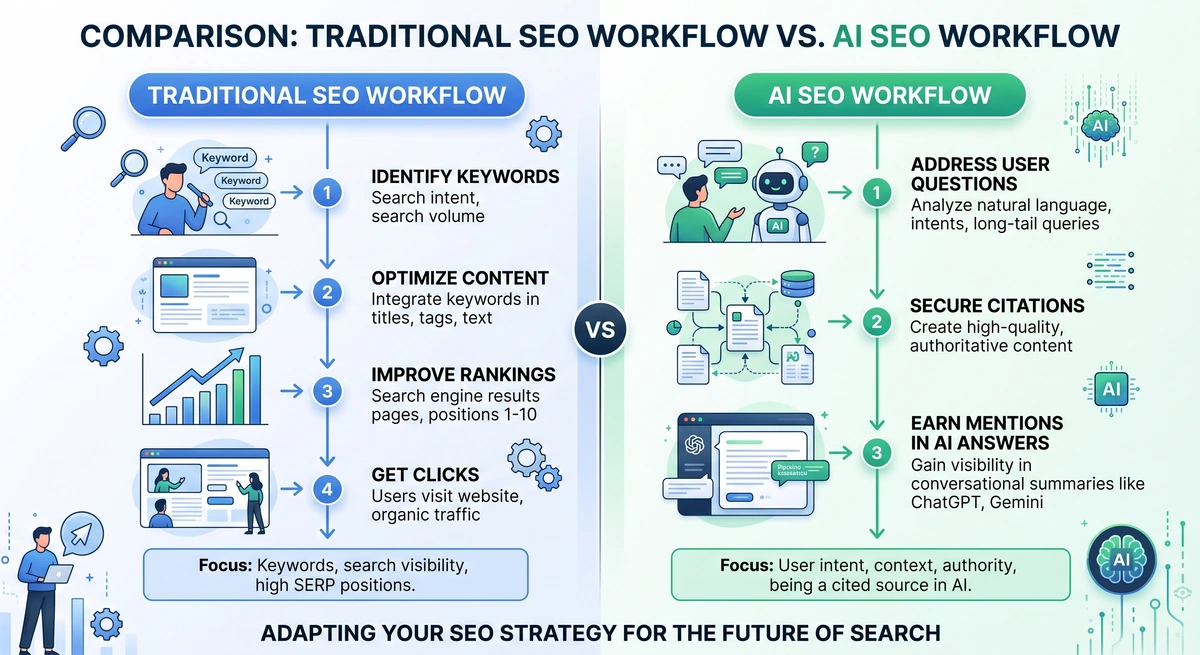
Traditional SEO optimizes for a ranked list of links, while AI SEO optimizes for being cited inside a generated answer. The foundations overlap heavily, because clean structure and authoritative content help both, but AI SEO adds new work: schema and entity consistency matter more, direct question-and-answer content earns citations, and success is measured in AI mentions and citations rather than rankings alone.
Can an agency guarantee my business shows up in ChatGPT or Google’s AI Overviews?
No, and you should treat any guarantee as a red flag. Nobody controls what AI engines cite. A legitimate AI SEO agency will explain what it can influence (site structure, content quality, authority signals, entity consistency) and show you evidence of past citations it has earned, without promising specific placements or lead counts.
How long does it take to see results from AI SEO services?
Technical readiness lands fast, usually within the first few weeks. Earned citations take longer: months for low-competition queries, longer for crowded ones, since AI engines favor sources with established authority. The work compounds, so visibility tends to accelerate once the foundation is in place. Any promise of instant AI visibility deserves the same skepticism as a promise of instant rankings.
How much do AI SEO services cost?
Expect pricing similar to technical SEO plus content strategy: project-based audits and fix sprints at the low end, ongoing retainers for content and measurement at the high end. The bigger cost question is ownership. Make sure the structured data, content, and analytics the agency builds live in accounts you control, so you keep the value if you ever leave.
Do I still need traditional SEO if I invest in AI SEO?
Yes. Research shows 85% of people who start with an AI answer still verify it through traditional search, and Google attaches AI Overviews to roughly 16% of queries, which means most searches still involve a classic results page. The smart move is one strategy that feeds both surfaces, since the same clean structure and citable content win in each.