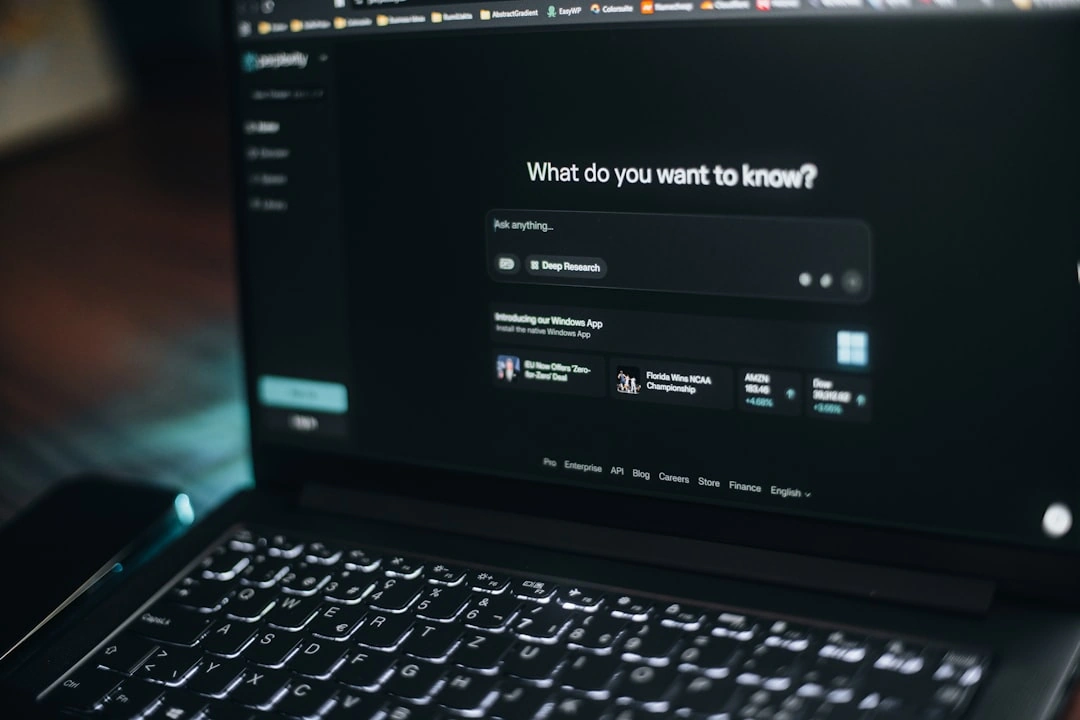
Generative Engine Optimization: A Practitioner Guide
Generative engine optimization (GEO) is the practice of structuring your content, brand presence, and technical site setup so that AI assistants like ChatGPT, Perplexity, Google AI Overviews, and Claude cite your business when they answer questions in your category. It’s a separate discipline from traditional SEO. You can rank number one on Google for a query and still be invisible in the AI-generated answer above the blue links.
The shift matters because more buyers now ask an assistant before they ask a search engine. If your brand isn’t part of the assistant’s answer, you don’t exist in that buyer’s research process. Below is the practitioner-level playbook we use to put clients in those answers, including the technical setup, the content structure, and the brand-mention work that actually moves the needle.
How AI search engines decide who to cite
AI assistants don’t pull answers straight from training data. They use a pattern called retrieval-augmented generation: when a user asks a question, the system retrieves a small set of pages it considers trustworthy and topically relevant, then generates an answer using those pages as the source. The whole game is being in that retrieved set.
Four signals decide whether your pages get retrieved:
- Topical authority. Does the assistant already associate your brand with the subject? This is built through repeated mentions of your brand alongside the topic across credible sources, not just through links to your site.
- Content structure. Can the assistant extract a clean, self-contained answer from your page? Pages that lead with the answer and use clear, scannable headings beat long-form essays that bury the point.
- Freshness. AI assistants strongly prefer recent content, especially in categories that change quickly.
- Crawler accessibility. If your robots.txt blocks the AI crawlers, none of the above matters. The assistant can’t cite what it can’t read.
Get all four right and your pages enter the rotation. Once you’re in rotation, the citations compound: each mention strengthens the brand-topic association, which makes the next retrieval more likely.
How GEO differs from traditional SEO
| Dimension | Traditional SEO | GEO |
|---|---|---|
| Goal | Rank in the list of links | Get cited in the synthesized answer |
| Primary signal | Backlinks | Brand mentions across the web |
| Content shape | Long, comprehensive articles | Answer-first, scannable, extractable |
| Authority | Domain rating, referring domains | Entity recognition + topical consistency |
| Measurement | Position, click-through, organic traffic | Citation share, AI referrer traffic, brand mentions |
You can’t do GEO well by retrofitting your existing SEO playbook. The signals are different, and the content shape that wins traditional SEO often loses in AI search. A 3,000-word essay that ranks on Google might get skipped entirely by an AI assistant that needs a clean two-paragraph answer it can quote.
The practitioner playbook
The work splits into four categories: technical setup, content structure, brand-mention strategy, and entity consistency. Most engagements run all four in parallel.
1. Technical setup
Open the door for AI crawlers. Audit your robots.txt and confirm that GPTBot, ClaudeBot, PerplexityBot, OAI-SearchBot, and Google-Extended are not blocked. We see this misconfigured on roughly one in twenty SMB sites. Often it was set up by a previous developer who copied a “best practice” snippet that pre-dated AI search. If you would rather have an AI agent run this check for you, our MCP server for SEO reports which crawlers a site allows or blocks on command.
Ship structured data. Schema.org markup is non-negotiable for GEO. The minimum: Organization on every page, LocalBusiness if you have a physical location, Product on commerce pages, Article on blog posts, FAQ on any page with a frequently-asked-questions section. Beyond that, the high-impact additions are HowTo for tutorials, BreadcrumbList for navigation context, and Person markup for author bylines. The goal is to give the AI a machine-readable description of what each page is, not just what each page contains.
Publish llms.txt. A small but growing pattern: a file at /llms.txt that points AI assistants to your most-citable pages and resources. We add this to every client site we build.
Watch your Core Web Vitals. AI assistants don’t punish slow sites the way Google does, but they’re more likely to retrieve from sites that load cleanly and render predictably. If your site fails LCP or has heavy CLS, fix it.
2. Content structure
Lead with the answer in the first 100 words. Every page should be readable as a clean answer in the first paragraph. The AI is going to scan for the most extractable answer to the user’s question and quote from there. If your best line is in paragraph fifteen, the assistant trims it out.
Use scannable H2s that mirror the questions buyers ask. Not “Our Approach to Marketing.” Use “What is generative engine optimization?” or “How do I get my product listed in ChatGPT?” Each H2 becomes a discrete chunk the AI can extract.
Add a Frequently Asked Questions block to every authoritative page. Each question, each answer, each one self-contained. This is the single cleanest format for AI retrieval, because the question-answer structure maps directly to the way assistants are prompted.
Include named tools, named numbers, named clients. Generic content gets passed over. Specific content gets cited. When we wrote about our Shopify SEO Overhaul, we named the exact issue counts (97,513 total issues, 10,738 critical errors), the exact page count crawled (4,100+), and the exact outcomes (99.9% error reduction, 52% sales lift). Those numbers became citation hooks.
Refresh quarterly. Update the publish date on your strongest content, swap in newer examples, remove stale claims. AI retrieval favors fresh material, especially in fast-moving categories. The same discipline applies to the analytics underneath: if your tracking is broken, you can’t tell whether the refresh moved the needle, which we covered in why most SMB marketing reports lie.
3. Brand-mention strategy
This is the move most agencies miss. AI assistants weigh brand mentions across the web more heavily than they weigh backlinks for retrieval decisions. Every time your brand appears on a credible site in the context of a topic, the assistant strengthens that association.
The practical work:
- Pitch journalists and analysts using HARO-style platforms like Qwoted, Help A B2B Writer, and SourceBottle. Each accepted pitch becomes a brand mention on a trusted publication. The mention itself, even unlinked, builds the topical association.
- Get on industry podcasts. Audio gets transcribed and indexed. Hosting transcripts on the podcast site means your brand and your topic land on a credible domain.
- Show up in industry roundups. Reach out to publishers running “best of” or “top X” lists in your category. Even a one-line mention has retrieval value.
- Earn product reviews on review sites. G2, Capterra, and category-specific review sites are heavily weighted by AI assistants for product recommendations.
This is where SEO and GEO start to look the most different. Old-school SEO chased link equity. GEO chases narrative consistency: the same brand, same topic, mentioned the same way, in many places.
4. Entity consistency across the web
AI assistants treat your business as an entity, a single identifiable thing in the world. They build that entity profile by reading every place your business appears online: your site, your Google Business Profile, your Crunchbase entry, your LinkedIn company page, your industry directories.
If those sources disagree (different name spellings, different descriptions, different service categories, different addresses), the assistant either resolves the conflict by trusting the most-authoritative source or skips you altogether.
The work:
- Pick canonical brand copy (tagline, short bio, longer description, services list, location).
- Audit every place your brand exists online and align each profile with the canonical copy.
- Set a quarterly drift check. Profiles drift when team members update them independently. A standing 90-day audit catches it.
The clients who get cited most in AI answers are the ones whose brand reads identically across twelve sources. The clients who get skipped are the ones with three different taglines and four different service lists across their public profiles.
A real example: schema markup that earned citations
When we audited the Shopify store featured in our Shopify SEO Overhaul case study, the technical SEO situation was bad but recoverable. The bigger opportunity was that the site had no structured data at all. Products had no Product schema, the brand had no Organization schema, the FAQs had no FAQ schema.
We shipped a complete markup pass: Organization on every page, Product schema with full pricing, availability, brand, and category data on each product page, BreadcrumbList for navigation, Article markup for blog posts, FAQ schema on every page that had a Q&A section.
Within a few weeks, products started appearing in AI Overview citations for category queries. Not because we’d written more content (we hadn’t), but because the AI could finally extract clean structured data about what the products were, what they cost, and where to buy them. The schema gave the assistant something to quote.
This is the most under-utilized GEO move in 2026. Most SMB sites still ship without proper schema, and most agencies don’t audit it as part of an SEO engagement.
Common GEO mistakes
- Treating GEO as a content-volume play. More articles isn’t the answer. Better-structured articles is the answer.
- Optimizing only for ChatGPT. Different AI assistants pull from different sources. ChatGPT favors brand sites and review platforms. Perplexity favors Reddit and recent news. Gemini favors Google’s own sources. A real GEO program covers all three. The agency you hire should already think this way, which is part of why an AI-augmented agency tends to win over a traditional one on this specific work. If you’re evaluating that route, we broke down what GEO services should actually include so you can compare providers on substance.
- Writing for AI instead of for humans. Awkward keyword stuffing, robotic sentence patterns, machine-friendly bullet lists with no human voice. AI assistants are now sophisticated enough to detect this and deprioritize it. Write for humans, then make it extractable.
- Skipping the brand-mention work. Site-only optimization caps out fast. The compounding wins come from your brand appearing in the right places off-site.
- Blocking AI crawlers without realizing it. Audit your robots.txt today, not next quarter.
Frequently Asked Questions
What is generative engine optimization?
Generative engine optimization is the practice of making your content and brand discoverable by AI assistants like ChatGPT, Perplexity, Google AI Overviews, and Claude. The goal is to be cited when the assistant generates an answer in your category. It draws on traditional SEO techniques (clean technical setup, structured data, authoritative content) but adds a focus on brand mentions across the web, entity consistency, and answer-first content structure.
Is GEO the same as SEO?
No. They share some technical foundations (structured data, fast load times, crawler accessibility) but the goals and signals diverge. Traditional SEO optimizes for ranking position in a list of links. GEO optimizes for citation in a synthesized answer. The most important GEO signal is brand mentions across credible sites, while traditional SEO has historically prioritized backlinks. A brand can rank well on Google and still be invisible in AI search, or vice versa.
How do I know if my brand is being cited by AI assistants?
The simplest test: go to ChatGPT, Perplexity, and Google AI Mode and ask the kinds of questions your buyers would ask. See whether your brand appears in the answer or in the cited sources. Tools like Profound and Otterly are also starting to track brand citations across major AI platforms, but a manual audit is still the most reliable starting point.
What is the most important first move for GEO?
Audit your robots.txt for blocked AI crawlers, then ship complete schema markup across your site. Those two technical moves unblock everything else. After that, focus on answer-first content structure and a brand-mention strategy that puts you on credible third-party sites in your category.
How long does GEO take to show results?
Faster than traditional SEO. Schema markup and content restructuring can produce citation appearances within weeks, not months, because AI retrieval pulls live data more aggressively than the Google index updates. Brand-mention work compounds more slowly, but most clients see meaningful citation lift within one to three months of starting.
Do AI assistants count traditional backlinks?
Yes, but less than you might expect. Backlinks still matter as one signal of authority, but research across major AI platforms suggests that brand mentions, even unlinked ones, correlate more strongly with AI search visibility than backlinks do. The simplest interpretation: AI assistants care that you exist in the conversation, not just that other sites link to you.
The bottom line
GEO is the SEO discipline of the next decade, and the small businesses that take it seriously now will compound a lead that’s hard to close later. The work is technical (schema markup, crawler accessibility, structured data), editorial (answer-first content, scannable structure, FAQ blocks), and reputational (brand mentions across credible sources, entity consistency).
None of it is exotic. All of it requires discipline and a real practitioner team. The brands showing up in ChatGPT and Perplexity answers right now aren’t running a secret playbook. They’re running a careful one.
Want your brand showing up in ChatGPT, Perplexity, and AI Overviews? Grade your site's AI visibility in seconds, then talk to us about a GEO program grounded in real client work, not hype.
Grade Your Site's AI Visibility