
Small Business Branding: Why Clarity, Consistency, and Intentionality Beat Budget
Most small business owners I talk to treat branding like a luxury. Something they’ll get around to after they have more customers, more revenue, more time. That mindset is backwards. Small business branding is how you earn the customers and revenue in the first place, and waiting until you can “afford” it usually means you’ve already spent years competing on price because people could not tell you apart from the next option.
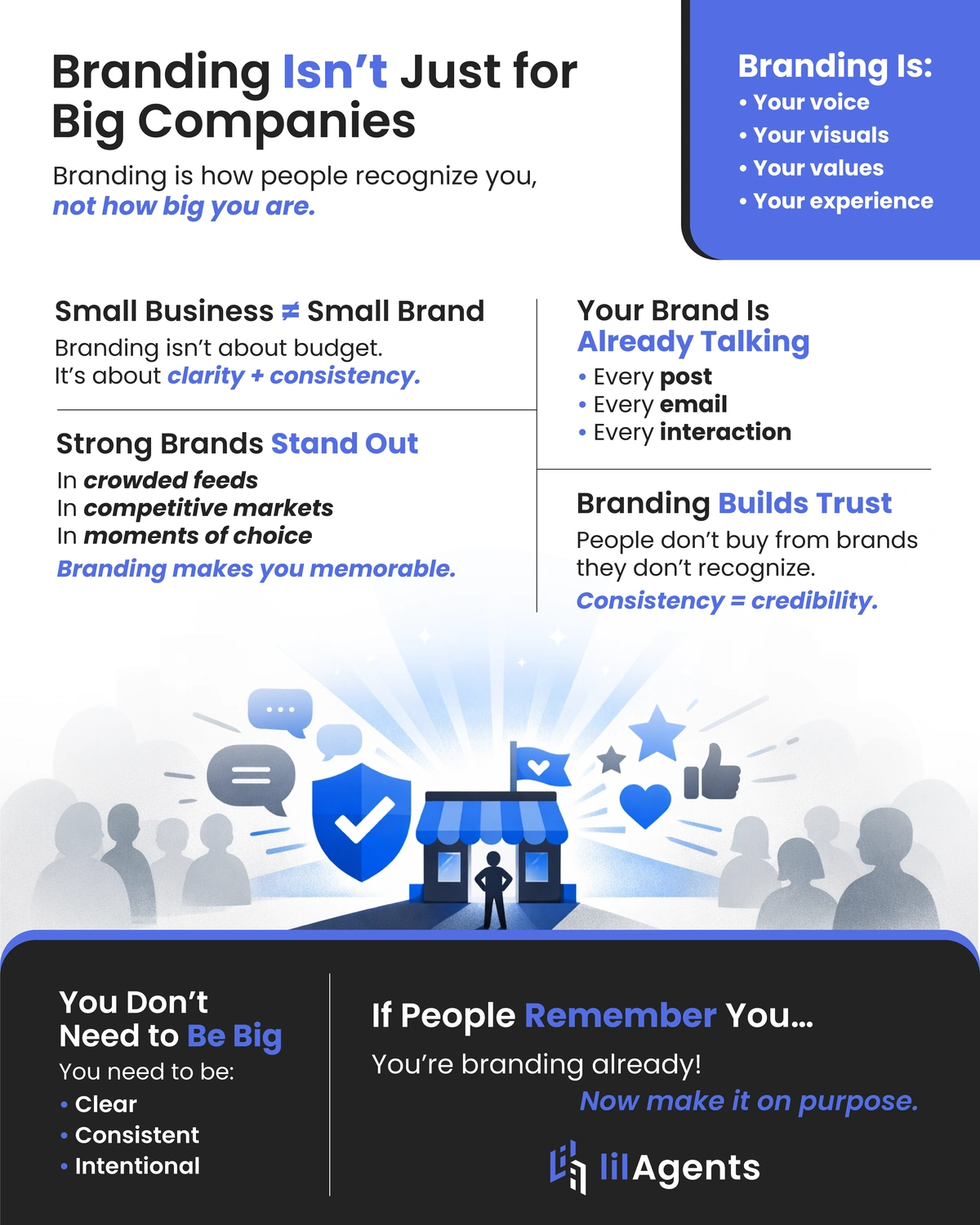
The truth is simpler than most agencies let on. Branding for small business is not about the size of your budget. It is about clarity, consistency, and intentionality. Three things that cost nothing but attention.
Small Business Doesn’t Mean Small Brand
When people hear “branding” they picture Nike swooshes and Coca-Cola commercials. That is not what we are talking about. Branding is how people recognize you, and recognition does not scale with company size. A two-person landscaping crew can have a brand that feels more put-together than a regional competitor with ten trucks, and customers will notice within three seconds of seeing the business card.
Nielsen’s 2022 research on brand awareness confirmed that brand awareness remains marketers’ top priority, with new customer acquisition as the close second. Awareness is downstream of recognition, and recognition is downstream of brand consistency. That chain holds whether you are a Fortune 500 or a family-owned bakery.
The Three Pillars Small Business Branding Actually Needs
Every productive conversation I have with a small business owner about branding comes back to the same three words. Not logo. Not color palette. Not brand guidelines document. The three things that actually move the needle are clarity, consistency, and intentionality.
Clarity Gives Your Customers a Reason to Listen
If your audience has to work hard to figure out what you do or who you do it for, they leave. They do not send you a message asking you to explain. They scroll past, click away, and land on a competitor who made it easy. Clarity is not about having the cleverest tagline in your industry. It is about somebody reading one sentence on your site and knowing whether you are the right fit for them.
I ask every new branding client two questions before anything else. Who do you serve, and what do you change for them? If the answers take more than two sentences, we have our first problem to solve.
Consistency Gives Them a Reason to Trust
People do not buy from brands they do not recognize. Recognition feels like safety, and safety feels like trust. A 2019 Lucidpress study reported that consistent branding can increase revenue by up to 33%, which was already a 10% jump from their 2016 number. That gap is not because consistent brands have magic. It is because consistent brands do not force customers to re-learn who they are every time they show up.
Consistency means your logo looks the same on your invoice as it does on your Instagram. It means the tone you use in an email matches the tone of your website. It means a customer who met you at an in-person event can find your business online and confirm they are in the right place within one glance. That alignment is the quiet work that compounds over time.
Intentionality Gives Them a Reason to Stay
The first two pillars get people in the door. Intentionality is what keeps them coming back. Every brand touchpoint is a decision you either made on purpose or defaulted into, and customers feel the difference even when they cannot name it. A business card that feels like an afterthought is an afterthought, and that is the message you are sending.
Intentionality does not require a big budget. It requires caring. When Jon designs for our clients, we ask why before we ask what. Why this typeface? Why this color? Why this voice? If we cannot answer the why, we do not ship the piece. That process works the same whether you have a team of fifty or you are running the whole business from your truck.
Your Brand Is Already Talking, Whether You Planned It Or Not
Here is the part most small business owners miss. You already have a brand. Every post you publish, every email you send, every interaction you have with a customer is building one, whether you are thinking about it or not. The question is whether the brand you are accidentally building is the one you want.
This is also where ownership matters. A brand built entirely inside someone else’s platform, on rented software and disappearing social accounts, is a brand you do not fully control. The visuals, the tone, the customer relationships, all of it needs to live somewhere you own. Your website. Your email list. Your customer records. That is why we treat vendor lock-in as a real brand risk, not just a technical one. If the platform changes its rules or shuts down, everything you built inside it goes with it.
The small businesses that win over a decade are the ones that treat their brand like an asset they own, not a subscription they rent.
Brand systems and brand code delivered as real source files. See how we ship brand work.
See design servicesWhat Strong Small Business Branding Looks Like in Practice
Strong branding for small business is boring in a good way. It does not require a rebrand every quarter. It does not need a 40-page brand book nobody reads. It needs three things you actually use.
First, a visual identity you can apply in ten seconds. A primary logo, two color values, and one typeface decision. That is enough. If you have to open a PDF every time you post to Instagram, your brand kit is too complicated.
Second, a voice you can describe in a sentence. Not “friendly and professional.” Everyone says friendly and professional. Something specific. “Straight-talk with dry humor, like a mechanic who knows what they are doing and does not oversell you.” That kind of description tells anyone writing for your brand exactly what to aim for.
Third, a short list of what you will and will not do. What topics you post about. What customers you say no to. What promises you refuse to make. That list is where your brand gets its edges, and edges are what make a brand memorable instead of generic.
Common Mistakes Small Businesses Make With Branding
I see the same handful of mistakes over and over. The good news is each one is fixable without a massive budget.
Constant logo tinkering. A small change every six months looks unsettled, not evolving. Pick a mark that works and commit for at least two years.
Inconsistent color usage. “Navy” on one post, “royal blue” on another, “teal-ish” on a third. Write down the actual hex code. Use it everywhere.
Tone whiplash. A casual Instagram caption followed by a stiff corporate email makes customers feel like they are talking to two different companies. One voice, across every channel.
Borrowed aesthetics. Copying the brand style of whoever is winning in your industry this month turns you into a lower-quality version of them. You are better off being imperfect and distinct than polished and forgettable.
No brand guardrails. When every post is a new experiment, the cumulative impression is noise. Set a narrow lane and stay in it long enough for customers to start expecting what comes next.
How to Start Branding On Purpose
If this post has you realizing your brand has been running on autopilot, the fix is not complicated. It is just deliberate.
Start by auditing what already exists. Look at your last twenty social posts side by side. Do they feel like the same business? Look at your website, your invoices, your email signature, and your business card together. Where are they pulling in different directions?
Next, write down the two-sentence version of who you serve and what you change for them. If you cannot do it in two sentences, the exercise is more important than the end product. Keep rewriting until you can.
Then pick one channel and make it the flagship. Get that single channel dialed in, visually and verbally, before you try to expand. A great website and a neglected Instagram beats two mediocre ones.
If you are past the DIY stage, this is where working with a team helps. Small business branding does not need to be expensive, but it does benefit from outside eyes that can spot the drift you have stopped noticing. The same principle applies to choosing your marketing team. We wrote more about how to think about that decision in what to look for in a digital marketing agency.
Be Memorable On Purpose
The businesses that survive crowded markets are not always the ones with the biggest budgets. They are the ones that decided, early, to be memorable on purpose. Clarity gives people a reason to listen. Consistency gives them a reason to trust. Intentionality gives them a reason to stay. That is the whole playbook.
You do not need to be a massive corporation to command respect in your market. You need to show up clearly, consistently, and on purpose, for long enough that people start to recognize you. Recognition turns into trust, and trust turns into revenue. The order matters.
And if you want help making that shift from accidental branding to intentional branding, our team builds brands that feel much larger than the businesses behind them. That is the whole lilAgents bet: enterprise-grade craft with the nimbleness of a small team, because the work does not have to scale with the company size. Just the intention behind it.
Frequently Asked Questions
What Is Small Business Branding?
Small business branding is the deliberate work of shaping how people recognize, remember, and describe your business. It covers the visual side, like your logo, colors, and typography, but also the non-visual side, including your voice, your values, and the experience a customer has at every touchpoint. Good small business branding makes you easy to identify and hard to confuse with a competitor.
How Much Does Branding Cost for a Small Business?
Branding for small business can range from a few hundred dollars for a basic logo and color palette to tens of thousands for a full identity system, custom photography, and brand guidelines. Most small businesses land somewhere in between, and the bigger factor is whether the investment is used consistently. A $500 logo applied everywhere beats a $10,000 logo nobody sees. For a broader look at agency-led pricing, our pricing guide for digital marketing agencies breaks down the ranges.
How Do I Increase Brand Awareness for My Small Business?
The fastest way to increase brand awareness is to show up in the same places, with the same visual identity and voice, for long enough that the repetition starts to feel familiar. That usually means picking one or two channels your customers actually use, posting consistently, and making sure every piece of content looks and sounds like it came from the same business. Paid ads can accelerate this, but they cannot replace the underlying consistency.
Why Is Brand Consistency Important for Small Businesses?
Brand consistency is what turns scattered impressions into recognition, and recognition is what builds trust. A 2019 Lucidpress study found consistent brands saw revenue increases of up to 33% compared with inconsistent ones, and the gap has only widened as customers see more brands per day than ever. For small businesses, consistency is also the cheapest competitive advantage available. You do not need more money to be more consistent.
How Do I Build a Brand for My Small Business Without a Designer?
You can get a usable brand foundation on your own by focusing on the three things that actually matter: a two-sentence description of who you serve, a single primary color paired with one neutral, and one typeface used everywhere. Free tools like Figma, Canva, and Google Fonts cover the technical side. The hard part is discipline, not tools. Stick with the choices you made long enough for customers to start recognizing them.
When Should a Small Business Hire a Branding Agency?
The right time to bring in outside help is usually when branding has become a bottleneck rather than a task. If you are turning down content opportunities because you are not sure what your brand “should” look like, or if you keep redesigning the same assets and never feel settled, an outside team can save you months of second-guessing. If you are still figuring out your core offer, the smarter move is to keep iterating on the DIY version until the offer stabilizes.