How to Pick an AI Search Visibility Tool
Google Ads keyword data puts a single click on the phrase “AI search visibility tool” at around $66, which tells you most of what you need to know about how this category is priced. Nobody bids sixty-six dollars for one visitor unless the software behind that click carries a fat monthly subscription and a long expected retention curve. Roughly a thousand people a month type the phrase in, dozens of products chase them, and the category is still arguing with itself about what the word “visibility” is even supposed to mean.
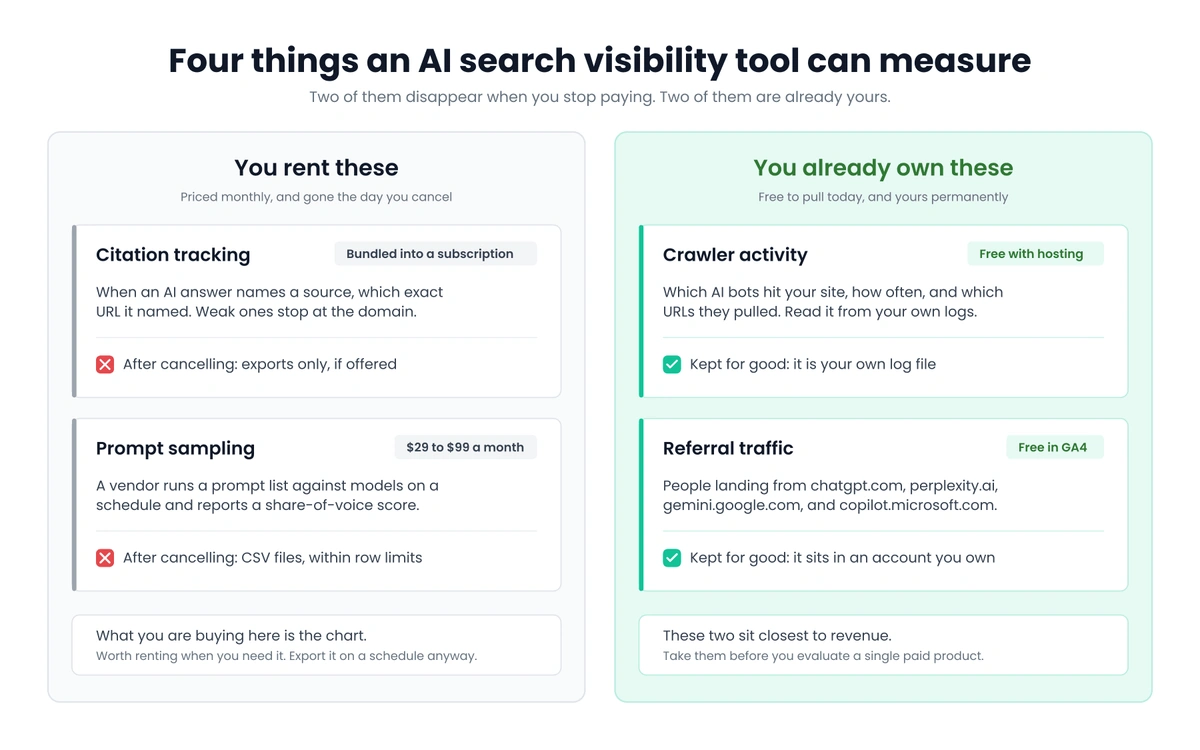
That argument is the actual problem with shopping this market, because two products both sold as an AI search visibility tool are often not measuring the same thing. Four different measurements hide under one label: two you can take for free today and keep forever, and two that disappear the day you stop paying. Sorting out which is which is most of the buying decision, so we will do that first and get to specific products second.
The demand behind the category is real, at least. Google now attaches an AI-generated answer to a meaningful share of searches, around 16% as of late 2025 according to Semrush’s AI Overviews study, and buyers are asking ChatGPT and Perplexity the same comparison questions they used to type into a search box. Measuring it is worth doing, and paying four separate prices for one underlying measurement is what we would like you to avoid.
The Four Things an AI Search Visibility Tool Can Measure
Every product in this category is some blend of four layers, and once you can name the layer a product leans on, its pricing starts to make sense.
Crawler Activity
Which AI bots hit your site, how often, and which URLs they pulled. In practice that means GPTBot, OAI-SearchBot, and ChatGPT-User from OpenAI’s published crawler list, ClaudeBot and Claude-SearchBot from Anthropic’s documentation, PerplexityBot and Perplexity-User, Google-Extended, and a roster that gets longer every quarter. Boring and completely factual, which is exactly why we trust this layer more than the other three.
Referral Traffic
Actual humans landing on your site from chatgpt.com, perplexity.ai, gemini.google.com, copilot.microsoft.com, and claude.ai. This is the only layer that touches revenue directly, and it is already sitting in your analytics account waiting for someone to segment it.
Citation Tracking
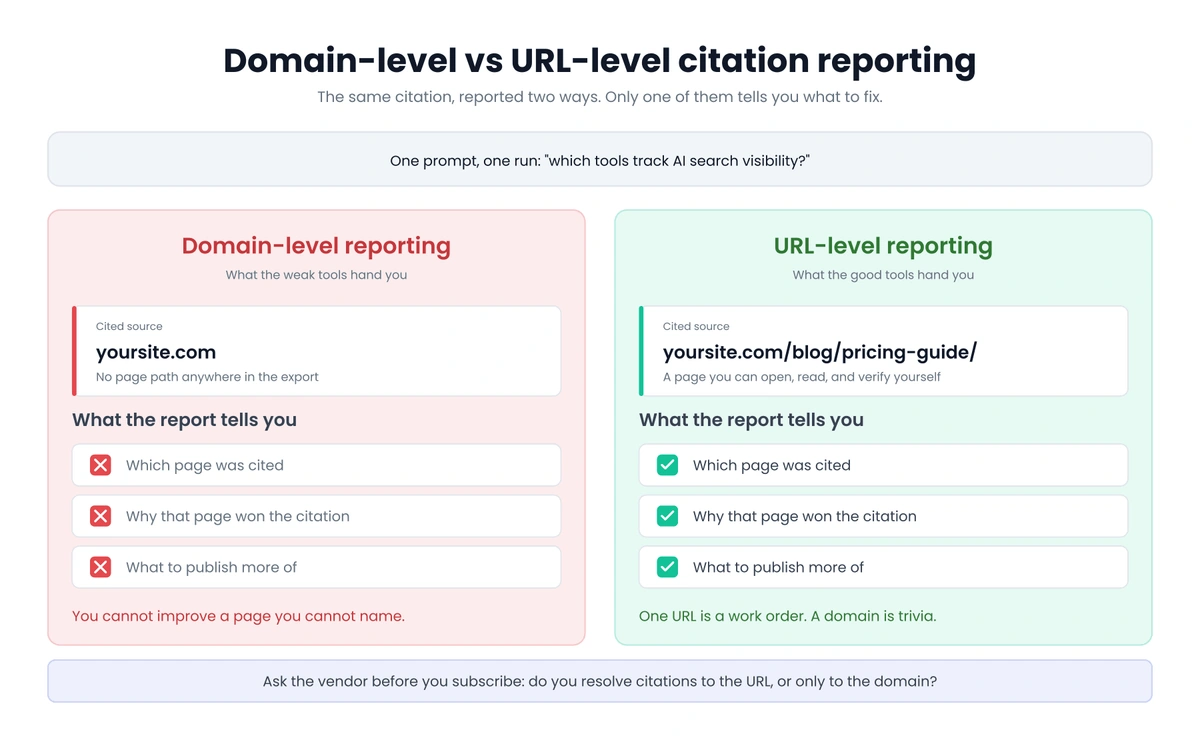
When an AI answer names a source, which URL did it name. The good implementations resolve down to a specific page you can open and read, so you can verify the claim yourself. The weak ones stop at the domain, which tells you almost nothing about what to go fix.
Prompt Sampling
The vendor runs a list of prompts against a list of models on a schedule, logs which brands come up, and rolls the result into a share-of-voice percentage or a proprietary visibility score. It is a poll with an undisclosed sample size, and it is where most of the subscription money ends up.
Two Layers No AI Search Visibility Tool Should Charge You For
Before you evaluate a single AI search visibility tool, go take the free data.
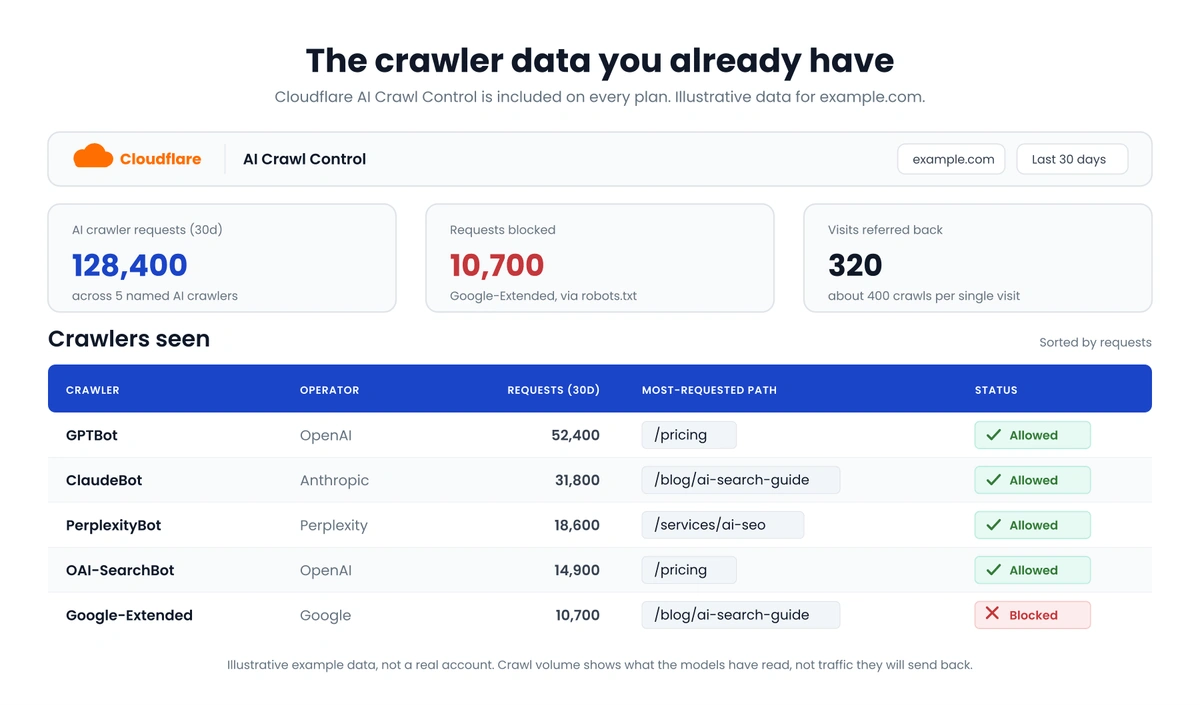
For crawler activity, pull your server or CDN logs. Cloudflare, Netlify, and Vercel all expose request logs with user agents, and Cloudflare’s AI Crawl Control breaks AI crawler hits out by name on every plan with no add-on. Filter for the user agent strings above, group by URL, and you have a monthly report on which of your pages the AI systems are actually reading. The first time we ran that report for a client, their most-crawled page by a wide margin was a pricing page they had already scheduled for deletion, and that single report changed what they published for the next six months. It cost them nothing.
One caveat on reading those numbers: crawl volume is not demand. Cloudflare’s crawl-to-refer analysis found Anthropic crawling roughly 38,000 pages for every visitor it sent back in July 2025, with OpenAI closer to 1,091 to 1 and Perplexity around 195 to 1, and training accounted for nearly 80% of all AI bot activity. Treat the crawler layer as evidence of what the models have read, not as a forecast of traffic.
Referral traffic is a GA4 exploration segmented on those hostnames. One gotcha before you report the number to anybody: some ChatGPT clicks arrive tagged with utm_source=chatgpt.com and some arrive with no referrer at all, which dumps them into Direct, so your true number is higher than the referral channel claims. Segment on landing page and UTM together and you will get closer to reality. If your current reporting flattens all of this into one cheerful line item, you are looking at the same failure mode we covered in why your reporting might be lying about leads.
Neither of these layers needs a tool, and both stay yours permanently. When an AI search visibility tool’s main job is handing those two layers back to you in a nicer chart, be clear with yourself that the chart is what you are buying.
How to Compare AI Search Visibility Tools by Layer
Here is the current field, grouped by the layer each product leans on. List pricing in this category moves almost monthly, so treat these numbers as directional and verify before you sign anything.
| Tool | Primary layer | Rough entry price | What you keep after cancelling |
|---|---|---|---|
| Cloudflare, Netlify, or Vercel logs | Crawler activity | Free with hosting | Everything, it is your log file |
| GA4 with UTM segments | Referral traffic | Free | Everything |
| DataForSEO AI Optimization API | Prompt sampling and citations | Pay per call, fractions of a cent | Every response you store |
| Otterly.AI | Prompt sampling | Around $29/mo | CSV exports |
| Peec AI | Prompt sampling and citations | Around 90 EUR/mo | CSV exports |
| Semrush AI Toolkit | Prompt sampling and sentiment | Around $99/mo on top of Semrush | Exports, within their row limits |
| Ahrefs Brand Radar | Prompt sampling and mentions | Bundled into higher Ahrefs tiers | Exports |
| Profound, Scrunch AI | Prompt sampling at enterprise scale | Enterprise contracts | Whatever you negotiate in |
Read the second column again. Most AI search visibility tools compete on one underlying measurement: ask models questions, count brand names. What separates the products is prompt volume, model coverage, refresh cadence, and how presentable the report looks in a meeting. Those are real differences and worth paying for when you need them, but they are four versions of one technology wearing four different price tags.
The API row deserves more than a single line, because it changes the arithmetic. DataForSEO’s AI Optimization API prices LLM mentions at roughly a tenth of a cent per data row with no monthly minimum, so running a couple hundred brand prompts across a few models on a weekly cadence lands in the low tens of dollars a month, and every raw response ends up as a row in a database you own. We pulled 105 keywords across 65 clusters for this site’s own content plan and it cost about nineteen cents in credits. If you have someone who can write a scheduled script, or you are already wiring an MCP server into your SEO workflow, that is the same measurement at a fraction of the price with none of the lock-in.
Where Building It Yourself Costs More
This is the part the ownership pitch usually skips, so we are not going to skip it.
Rolling your own prompt sampling is more work than it sounds and noisier than the marketing implies, including ours. Model outputs are non-deterministic, and in our runs the same prompt asked ten times in a row named a meaningfully different set of brands nearly every time, with mention rates swinging twenty points or more between runs. Getting a number stable enough to make a decision on takes repeated sampling, which means a harness, somewhere to store results, retry handling, and a view a human can read without squinting. Call it two days of setup plus a standing maintenance cost you will feel every time a model version changes underneath you.
A paid AI search visibility tool hands you all of that on day one, with a chart you can drop straight into a board deck, and there is genuine value in not having to build it. If you have no technical capacity in house, ninety-nine dollars a month beats measuring nothing at all, and we would rather see a business subscribe to something than fly blind on brand visibility in AI search for another year.
So the line we would hold is narrower than “do not buy tools.” Pay for the dashboard when you need the dashboard, but insist that the underlying data comes out as a CSV on a schedule, and land that CSV somewhere you control. Then the subscription is a convenience instead of a dependency, and if the vendor gets acquired or triples its price next spring, you still have your history. That distinction is the whole of what vendor lock-in actually costs you, applied to a category that is barely two years old.
Want to know what AI search actually sees on your site before you subscribe to anything? We will pull your crawler logs and your AI referral traffic, show you which measurement layer is worth paying for in your situation, and hand you the raw data either way. Everything we build stays in accounts you own.
Get a Free AI Visibility CheckWhat We Would Actually Buy
Starting from zero, take the crawler logs and the GA4 segments first, because they cost nothing and they sit closest to money.
Then pick one prompt-sampling AI search visibility tool on a monthly plan, run it for a full quarter, and export every single month. By the end of ninety days you will know whether the score moved for reasons you could act on or whether it just wobbled inside its own noise, and that answer is what tells you whether to renew.
What we would not buy is a composite visibility score we cannot reconstruct. When a vendor will not tell you the prompt list, the models, and the sample size behind their number, that number is a marketing asset with a decimal point on it, and it is not going to follow you out the door anyway.
Questions to Ask Any AI Search Visibility Tool Vendor
Take these into a demo and the field sorts itself fast:
- “Which of the four layers does your product actually measure, and which do you pull from my analytics?” You want the answer unbundled, not blended into one score.
- “What is your prompt list, which models do you run it against, and how many samples per prompt?” A confident vendor will tell you.
- “Can I export the raw responses on a schedule, rather than only the summary?” Raw responses are the part worth keeping.
- “What happens to my history if I cancel?” The right answer involves a file you already have.
- “Do you resolve citations to the URL or only to the domain?” Domain-level citation data cannot tell you which page to fix.
Most of that list is the same due diligence we would apply to any agency or platform, and it maps onto the questions in our guide to choosing a marketing agency, where ownership of the output is the through line too.
Measurement Is the Easy Half
Once the numbers are honest, the work shifts to the pages themselves: answer the question in the opening lines, keep facts in text rather than buried inside images, and publish the specific claims you want repeated back to you. We wrote the long version of that in our practitioner guide to generative engine optimization, and when we scored the Fortune 500 on AI agent readiness almost none of them passed the basics, which is why a small site that gets this right can out-position companies a thousand times its size in AI answers.
An AI search visibility tool is expensive right now because the category is early, and early is exactly when it pays to be careful about what you rent. Take the free layers now, buy the convenience when it genuinely saves you time, and keep a copy of everything either way.
Frequently Asked Questions
What is an AI search visibility checker?
It is a product that runs a set of questions against AI assistants and reports whether your brand or your URLs got named in the answers, usually alongside the competitors that showed up next to you. The useful ones show you the actual response text so you can verify the result yourself rather than trusting a score you cannot audit, and any checker that hides its prompt list and sample size is closer to a marketing surface than a measurement.
Does the Semrush AI search visibility checker replace a standalone tool?
For plenty of businesses, yes. If you already pay for Semrush, the AI Toolkit add-on covers prompt sampling and sentiment well enough that a second subscription gets hard to justify on top of it. Where it thins out is custom prompt sets and citation detail at the URL level, and those two gaps are exactly where the specialist products earn their price.
What are the best AI search visibility tools right now?
There is no single winner, and anybody ranking them without saying what each one measures is guessing. Pick by layer instead: logs and analytics for ground truth, an API for cheap repeatable sampling, and one subscription product when you need a reporting surface other people will look at. That combination beats any single product on the list.
How much should an AI search visibility tool cost?
Entry-level prompt-sampling subscriptions run roughly $29 to $99 a month, mid-market products land in the low hundreds, and enterprise contracts go wherever the sales team can take them. Pay-per-call APIs undercut all of it if you have someone who can schedule a script. The two layers closest to revenue, crawler logs and referral traffic, cost nothing at any tier.
How do I improve brand visibility in AI search once I am measuring it?
Start with the pages the crawlers already fetch most often, since those are the ones the models have demonstrably read. Answer the question in the opening lines of the page, keep your facts in plain text, keep your schema accurate, and publish the specific claims you want an assistant to repeat on your behalf. Our AI SEO service covers the full sequence, but the measurement only tells you where to aim and the content still has to do the work.