
Website Monthly Maintenance Fee: What It Really Buys
Almost every business owner we talk to pays a website monthly maintenance fee, and almost none of them can say what it buys. They know the number and they know the day it hits the card, and the explanation they got when they signed was some version of “hosting, updates, and support.” Those three words are standing in for three completely different kinds of cost, and the third one is rent.
We are not saying your agency is ripping you off. Plenty of monthly bills are honest and worth every dollar, and we would rather you keep a good vendor than fire one over a misunderstanding. But you cannot tell an honest bill from a padded one until you split the line item apart, and nobody who benefits from the bundle is going to volunteer to do that for you. So here is what a website monthly maintenance fee is made of, with real 2026 numbers, plus four questions that settle the whole thing in about two minutes.
One Line Item, Three Different Costs
Every monthly website charge is some mix of infrastructure, labor, and access. Infrastructure is what it costs to keep the site reachable on the internet. Labor is a human doing things: updates, fixes, small changes, and watching for problems before you notice them. Access is the money you pay for permission to keep using something you never got to keep.
Those three should never share a line, because they behave nothing alike. Infrastructure is a commodity with published prices you can look up in thirty seconds, labor is priced by hours and skill, and access is priced by how hard it would be for you to leave. Bundling them hides the only number that really matters, which is how much of your website monthly maintenance fee produces something you still own at the end of the month.
What Hosting Actually Costs in 2026
This is the number most people get wrong, usually by an order of magnitude.
A static marketing site, meaning a normal business site with pages, a blog, and some forms, hosts for free on Netlify or Cloudflare Pages at small business traffic levels. The free tier is a real tier, and the paid plan kicks in when you need more build capacity or team seats. Netlify’s pricing starts at $0 and the Pro plan is $20 a month for the whole team, Vercel Pro is $20 per user per month, and Cloudflare Pages does not meter requests to static assets at all, on any plan.
WordPress costs more because it runs code on every request instead of serving a file. WP Engine’s entry plan is $30 a month for one site and roughly 25,000 visits, and Kinsta’s single-site plan is $35 a month, or $30 billed annually. Cheap shared hosting runs $5 to $15 and you generally get what you pay for. A domain is $10 to $20 a year at a registrar that sells at cost, and SSL has been free through Let’s Encrypt for years, so a separate SSL line item on your invoice is telling on itself.
Add it up and the infrastructure floor for a typical small business site lands somewhere between $0 and $60 a month. Sites that genuinely need more have a reason someone can point at: heavy traffic, a members area, a search index, video delivery, or a database doing real work. Ask which one applies to you, and if the answer comes back vague, you have already found part of the problem.
The Labor Is the Legitimate Part
We want to defend this piece, because “just move to free hosting” is advice that ends with a broken contact form nobody notices for five weeks.
On WordPress, somebody has to run core and plugin updates on staging before production, watch for the plugins that break each other, keep offsite backups, monitor uptime, and clean up after a plugin author abandons a project. That last one is not hypothetical. Patchstack’s State of WordPress Security in 2026 counted 11,334 new vulnerabilities across the WordPress ecosystem in 2025, a 42% jump over the prior year, with 91% of them living in plugins and a weighted median time to first exploit of five hours. Five hours is faster than most owners check email, which is exactly why a maintenance retainer exists in the first place.
Licenses are real money too. Gravity Forms is $59 a year for a single site, ACF Pro is $49, WP Rocket is $59, and a site running five or six premium plugins is carrying a few hundred dollars a year before anyone touches a keyboard. For a small site, all of that adds up to maybe one to three hours a month of genuine work, and at $125 to $175 an hour you land between $150 and $500 a month for a retainer that includes a few small content changes. That is a fair price for a competent human who answers when something is on fire.
On a modern static stack the labor is lower, mostly dependency bumps and the occasional build fix, though it never drops to zero. Anyone telling you a site needs no attention at all has not run one for three years.
The Part of Your Website Monthly Maintenance Fee That Is Really Rent
Now the part nobody itemizes.
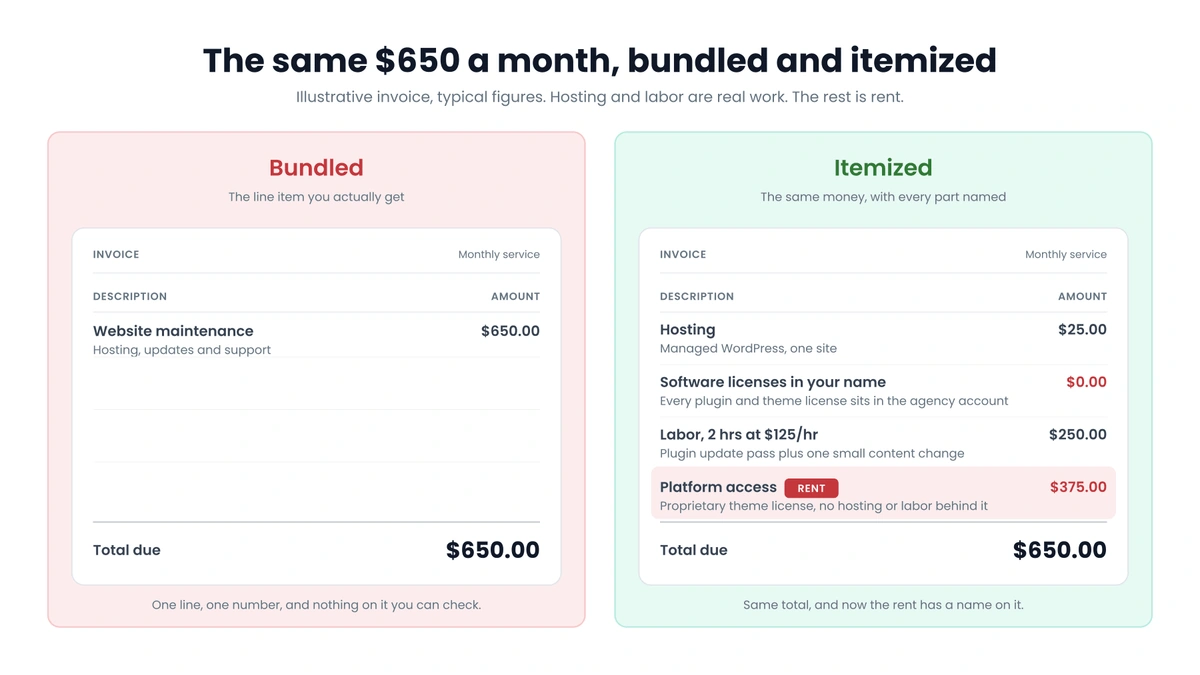
Here is a real example, lightly rounded from a bill we looked at earlier this year. A local services company was paying $650 a month. Hosting on that stack costs about $25. The actual work was a monthly plugin update pass plus roughly one small content change, call it ninety minutes, generously $250 at agency rates. That leaves about $375 a month with no name on it.
When we asked, the answer was “platform access.” The site was built on the agency’s proprietary theme framework, which was licensed to the agency and never to the client, so cancelling meant the site did not come along. That $375 bought the continued right to use a website they had already paid to have built. This is vendor lock-in wearing a maintenance costume, and it is the most common reason a monthly website maintenance fee stops making sense.
The test is always the same question: if you cancelled tomorrow, what would you still have? Honest hosting leaves you your files and your domain, and honest labor leaves you every improvement that labor already produced. Rent leaves you a dead site and a quote to rebuild it.
Rent usually shows up as one of these:
- Proprietary CMS access: the admin panel only exists on their servers, so your content has nowhere to go
- A borrowed page builder subscription: the license sits in the agency’s account instead of yours
- A platform fee: a monthly charge with no infrastructure or labor behind it
- A vendor-licensed theme or component library: the code that renders your site was never licensed to you
The Two-Minute Audit
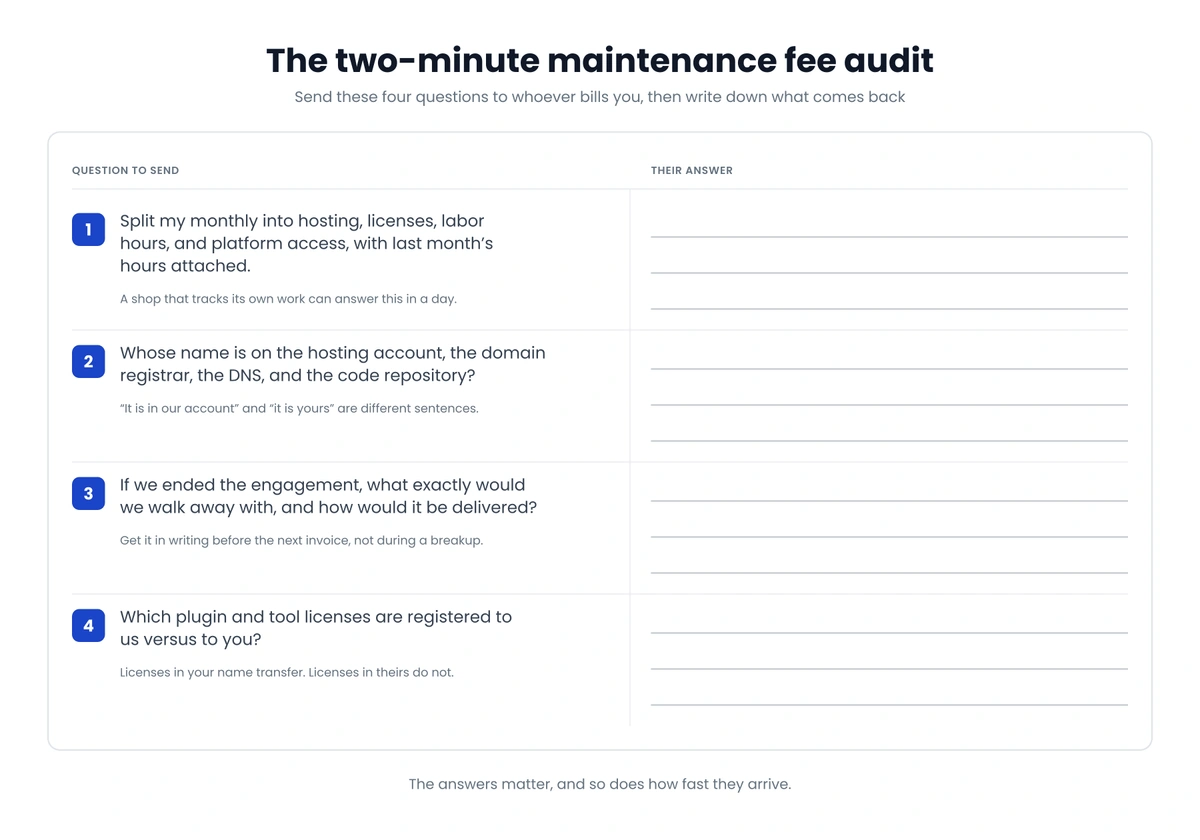
Send these four questions to whoever bills you. The answers matter, and so does how fast they arrive.
- Split my monthly into hosting, licenses, labor hours, and platform access, with last month’s hours attached. A shop that tracks its own work can answer this in a day.
- Whose name is on the hosting account, the domain registrar, the DNS, and the code repository? “It is in our agency account” and “it is yours” are two different sentences.
- If we ended the engagement, what exactly would we walk away with, and how would it be delivered? Get that in writing before the next invoice rather than during a breakup.
- Which plugin and tool licenses are registered to us versus to you? Licenses in your name transfer, licenses in theirs do not.
We put the same questions in our 2026 website build checklist, because they are much easier to ask before a contract than after one. If a vendor gets defensive about question two, you have your answer without waiting for the rest.
Pull your last invoice and send it over. We will split it into hosting, licenses, labor hours, and platform access, and tell you plainly which parts are real work and which parts are rent. No pitch attached, and anything we do build for you belongs to you from day one.
Get a Free Invoice BreakdownWhere Owning It Costs More, Honestly
We run an ownership-first shop, so you would expect us to say rent is always the wrong answer, and that is not quite true.
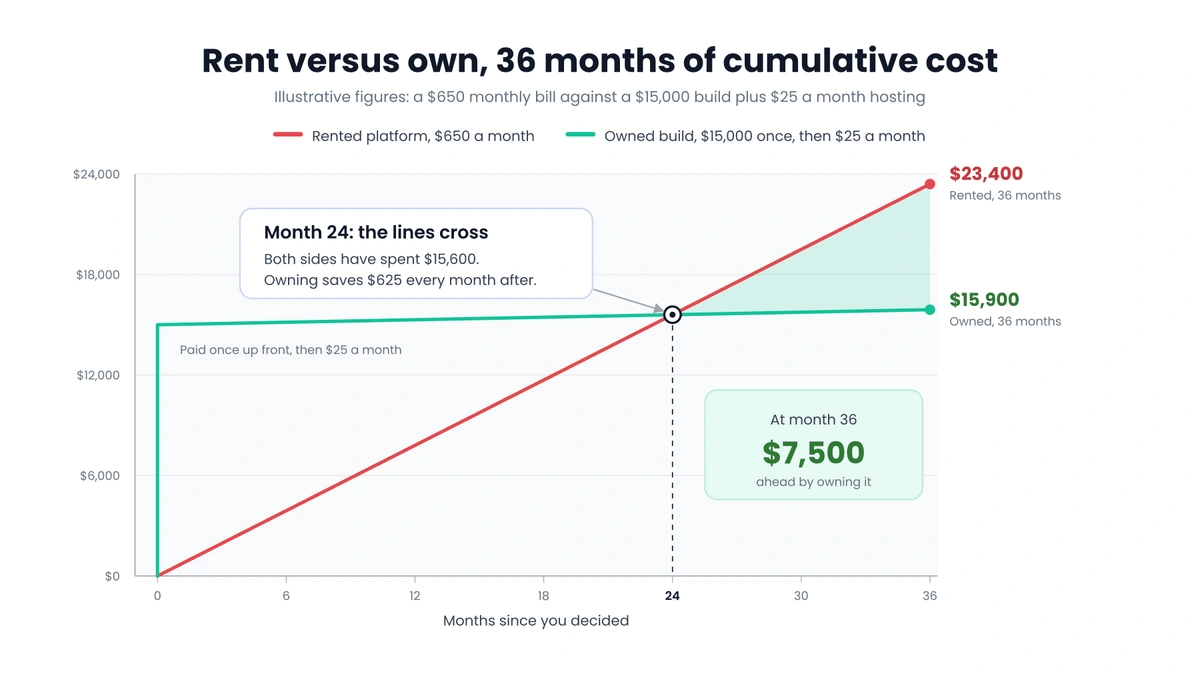
Moving off a builder platform onto a stack you own costs real money up front. A clean migration from Wix or Squarespace to something like Astro runs $4,000 to $15,000 depending on page count and how much of the content needs rewriting, and you probably will not recover that in saved subscription fees for two or three years. You also inherit responsibility. When a dependency gets a security advisory, scheduling that fix becomes your problem, and if nobody technical sits anywhere near your business, an owned site can rot without anyone noticing in a way a hosted builder never will.
For a solo practitioner with a six-page site who is never going to hire a developer, twenty-something dollars a month on a hosted builder is a good deal, and we will say that to their face. Rent starts to bite when the site earns real revenue, when you want to change vendors, or when the monthly has crept past what the work justifies. Past that point the math does the arguing for us, which is most of why we built lilAgents in the first place.
What a Fair Website Monthly Maintenance Fee Looks Like
For a static marketing site, expect $0 to $25 in hosting, a domain under $20 a year, and a support retainer of $150 to $400 if you want a human on call. No platform fee belongs on that invoice, because there is no platform to pay for.
For WordPress, expect $25 to $60 in hosting, $100 to $250 a year in plugin licenses registered to you, and $200 to $600 in maintenance depending on how much monthly change you actually request. Our 2026 agency pricing guide covers what happens above that band, where the money stops being maintenance and starts being marketing and development hours.
Anything above those ranges should map to a scope you can say out loud. A website monthly maintenance fee stops being defensible the second nobody can name what it produces. “We publish four blog posts and run two A/B tests a month” is a scope. “Platform access” is a toll.
If You Want a Second Read on Your Bill
Pull your last invoice and try the four questions. If the split comes back clean, you have a good vendor and you should keep them, and we mean that sincerely.
If the numbers do not add up, or you get “that is just how it works” instead of an itemization, we are happy to look. Worst case you walk away knowing what your site actually costs to run, which is information you should own regardless of who you hire.
Frequently Asked Questions
What is a normal monthly fee for website maintenance?
For a small business site, $150 to $500 a month covers hosting plus a real maintenance retainer with a few small changes included, and most honest vendors land somewhere in that band. Below $100 you are usually buying automated plugin updates and not much else, which is fine as long as you know that is what you bought. Above $800 there should be marketing work, content production, or development hours attached, and your vendor should be able to name them without checking with anyone.
Is there a website builder with no monthly fee?
Sort of, and the distinction matters. Static site generators like Astro, Eleventy, and Hugo are free and open source, and deploying them to Netlify or Cloudflare Pages costs nothing at small business traffic levels, so the software and the hosting can both genuinely be free. You still pay for a domain, and you still need somebody who can drive the tooling, so the skill is the real price of a website builder with no monthly fee.
What about a free website builder with no monthly fee, the drag-and-drop kind?
Free tiers on hosted builders do exist, and they come with a subdomain, platform branding, and no custom domain until you upgrade. They work well for testing an idea or standing up a placeholder while you figure out the real thing. They are a poor place to park a business that depends on traffic, mostly because the content and markup rarely export cleanly when you outgrow them.
Is a website design monthly fee ever legitimate?
Yes, in two situations. Some shops let you amortize a build over 12 to 24 months instead of paying up front, which is financing, and it should end when the balance does. Others run a design subscription where you receive ongoing design output every month, which is fine as long as the deliverables become yours as they ship. A website design monthly fee that renews forever and produces nothing new is rent with a nicer name on it.
What should be included in a website monthly maintenance fee?
At minimum, hosting and SSL, backups you can restore from, uptime monitoring, software and dependency updates tested somewhere other than your live site, and a named number of support hours for small changes. Anything beyond that (content production, SEO work, ongoing design) should appear as its own line with its own number attached. Everything included should be described in words you can repeat to someone else without looking at a slide.
Can I cancel a website monthly maintenance fee and keep my site?
That depends entirely on who owns the pieces, which is why the ownership questions come before the price questions. If the domain, the code repository, the hosting account, and the plugin licenses are all registered to your business, cancelling is a transfer and your site keeps running. If any of those sit in the vendor’s account, cancelling can mean losing the site, so get the answer in writing well before you plan to leave.