How to Rank on ChatGPT: What Actually Gets Cited
Anyone working out how to rank on ChatGPT hits the same wall early: there is no position one, no blue link ladder, and no rank tracker that means much of anything. Someone asks for the best commercial roofing contractor in Tacoma, the model writes a paragraph, and three or four citations hang off the end of it. You are either in that paragraph or you do not exist for that question, and there is no gentle slope between the two the way there used to be between page one and page two.
So we push back on the verb before answering anything else. The useful question is what makes a model reach for your page while it assembles an answer, and that comes down to whether it can crawl you at all, whether your page is easy to quote, and whether you have said something nobody else bothered to say.
None of that requires a subscription, which is the part we like about this work. Everything you build to rank on ChatGPT also works in Google’s AI Overviews, Perplexity, and Claude, because they are all reading the same open web, and it keeps working if you fire your agency tomorrow.
How to Rank on ChatGPT When There Is No Ranking
Start with the part almost nobody checks: whether ChatGPT can read your site at all.
OpenAI runs three separate crawlers and they do different jobs, documented on OpenAI’s own bots page. GPTBot pulls content for training foundation models, OAI-SearchBot builds the index behind ChatGPT’s search answers, and ChatGPT-User fetches a page live when a specific user question requires it. Blocking GPTBot while allowing OAI-SearchBot is a defensible position if you would rather your writing stay out of a training set, but block all three and you have opted out of being cited anywhere in the product.
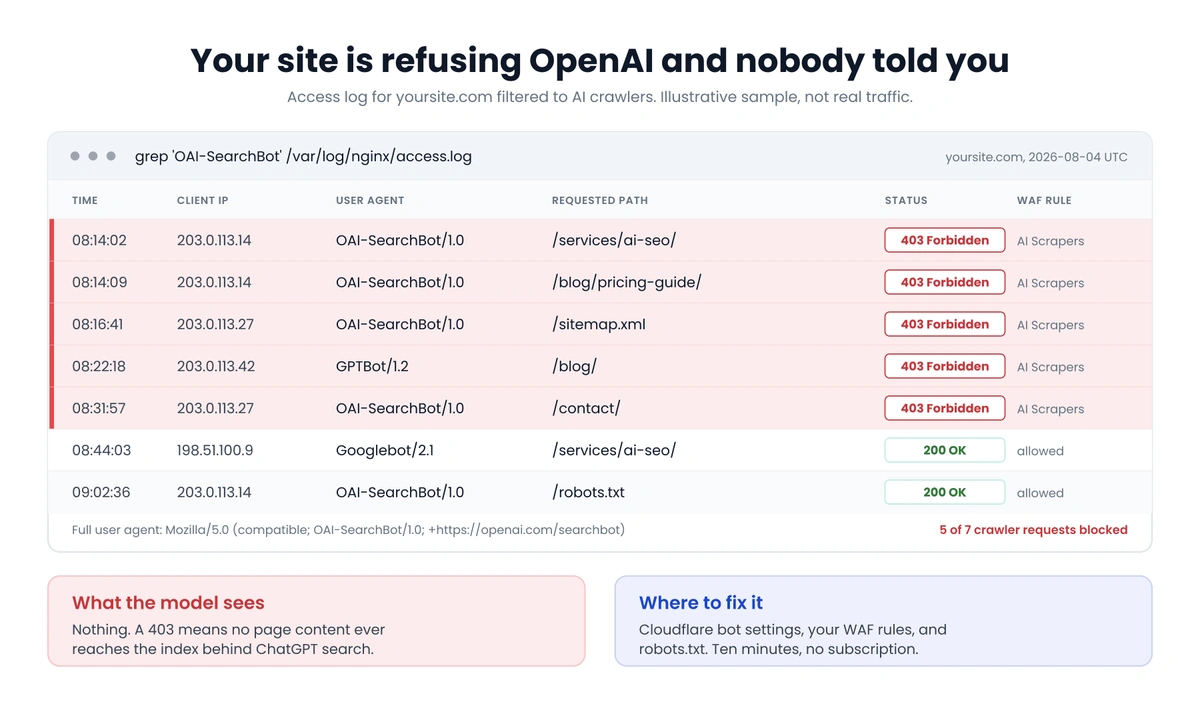
Here is where this bites people. Cloudflare changed its default to block AI crawlers on new domains on July 1, 2025, and plenty of sites sitting behind a WAF are handing 403s to OAI-SearchBot without anyone on the marketing side knowing. We have opened server logs on client sites and found months of blocked AI crawler requests stacked up behind a setting nobody remembered turning on.
Go look at yours. Grep your access logs for OAI-SearchBot and check what status code you are returning, and if you cannot get to raw logs, Cloudflare’s bot analytics shows you the same thing in about ninety seconds. Then read your own robots.txt out loud, because a Disallow: / under a wildcard user agent, left over from a staging environment, is the most common reason a site is invisible to AI search. It costs nothing to fix, and no amount of content strategy makes up for it. When we scored the Fortune 500 on AI agent readiness, most of them failed on exactly this tier of basics, so the bar here is lower than it looks.
Write Pages a Model Can Actually Lift
Once a crawler can reach you, the question becomes whether your page is quotable.
Models pull passages out of pages. The unit of citation is a two to four sentence chunk that fully answers one question on its own, so a page built as a long argument with the payoff in paragraph fourteen gets passed over for a page that answers in the first fifty words. That is the reverse of the build-tension-then-reveal structure that works fine in a newsletter, which is why a lot of genuinely good writing gets ignored in AI answers.
The Structural Moves That Matter
Question-shaped H2s. Match how people actually ask. “What Does a Website Redesign Cost in 2026” earns citations that “Our Pricing Philosophy” never will.
Self-contained answers under each heading. If a sentence only makes sense after reading the previous section, it cannot be lifted cleanly, and a model will reach for a competitor who wrote a standalone version of the same point.
Specific numbers with dates attached. “Around $12,000 to $30,000 for a ten-page marketing site in 2026” is quotable in a way that “varies based on scope” never is.
Comparison tables. Extraction from a table is trivial, and tables show up in AI answers well out of proportion to how often they appear on the web.
Real schema markup. Organization with a sameAs array, Article with a named author who has an actual bio page, FAQPage where you genuinely have FAQs, Product with real prices. Google’s structured data guidance is blunt about the rule that keeps this honest: mark up information that is visible on the page, and skip the empty pages built only to hold JSON-LD. This is a block of code in your own repo, not a plugin subscription.
All five moves are structural, which is the useful part. They live in your source files, they survive a redesign, and nobody can bill you monthly for them. This is the practical core of generative engine optimization, and it looks a lot more like writing well than like the keyword games that got people to page one in 2015.
Google lands somewhere interesting on all of this, and the two systems get conflated constantly, so it is worth being precise. Google’s own documentation on AI features in Search says there are no special optimizations for AI Overviews and AI Mode, only the same technical fundamentals plus useful content. Take them at their word. The pages earning Overview citations are usually already ranking in the top ten, so treat that channel as an extension of your search work rather than a separate program with its own invoice.
The Half of ChatGPT Visibility You Do Not Own
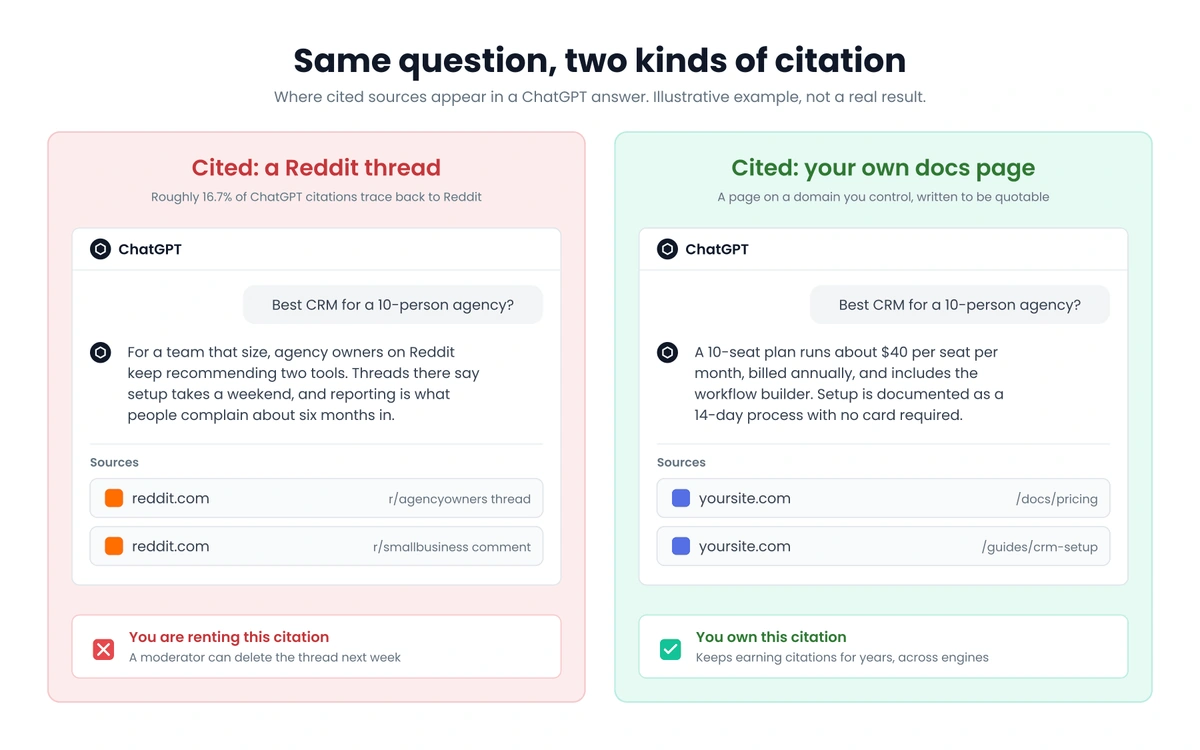
A large share of what ChatGPT cites for commercial questions comes from somewhere other than vendor websites. Ahrefs’ running tally of the most-cited domains in ChatGPT puts Reddit on top at roughly 16.7% of citations, with Wikipedia a distant second around 8.9%. Ask any model which project management tool suits a five-person agency and watch how much of the answer traces back to a subreddit thread and a G2 category page.
That sits awkwardly next to how we usually talk about this work, and we are not going to pretend otherwise. We tell founders to own their assets outright, and then the tactic that moves AI visibility fastest is showing up credibly in places they will never own.
What we do say is that the two halves have different half-lives. A Reddit comment cited today can be deleted by a moderator next week, and a listicle you paid to appear in drops you the month you stop paying. A page on your own domain with a clean schema block and a genuinely useful answer keeps earning citations for years, across every engine reading the open web. So do both, and keep an honest ledger of which half you are renting, because that is the same vendor lock-in math that applies to your hosting and your ad accounts.
What It Costs to Rank on ChatGPT, Honestly
This approach is slower than buying ads and the feedback loop is worse.
With Google Ads you change a bid and watch cost per lead move inside a week. Here you publish a well-structured answer page and wait somewhere between four and twelve weeks to learn whether anything changed, because the index behind ChatGPT refreshes on its own schedule and the model’s answer to the same prompt varies run to run. No dashboard hands you a clean number, and anyone selling you one is selling a sampled approximation of a nondeterministic system.
Set your traffic expectations accordingly. Pew Research found that when an AI summary appeared, only 8% of users clicked a traditional search result compared with 15% when no summary was present, and just 1% clicked a link inside the summary itself. Visibility in AI answers buys you brand presence and consideration far more than it buys you sessions, so if your entire case for the work rests on a traffic line going up, the numbers will disappoint you.
The other cost is that none of this rescues thin content. Publish forty pages of the advice everyone else already published and no model has a reason to prefer your version. The pages that get pulled carry something only you could write: your actual pricing, your process, a number from your own client data, a comparison you ran yourself. That takes real hours from people who know things, which is more expensive than a content mill and also the only version of this that works. Our breakdown of what belongs in generative engine optimization services walks through where those hours usually go.
Want to know why ChatGPT is citing your competitor instead of you? We'll run the prompts, read your server logs, and show you exactly what is blocking you. Everything we build to fix it lives in your repo and your accounts, so it keeps paying off whether or not we stick around.
Get an AI Visibility TeardownMeasuring How You Rank on ChatGPT With Data You Keep
You can get most of the way here without buying a visibility platform.
OpenAI appends utm_source=chatgpt.com to outbound links, so in GA4 you can build an exploration filtered on that parameter and see which pages earn clicks out of ChatGPT. Set it up once, then export the report monthly to a CSV or a Sheet so the history lives somewhere you control rather than inside a tool you might cancel.
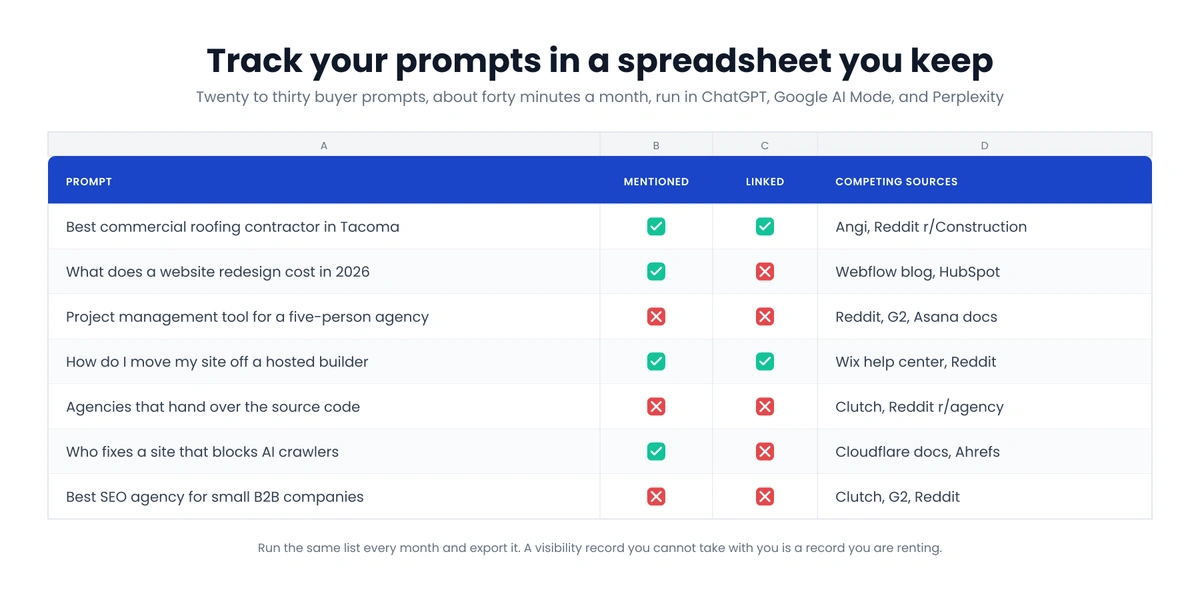
For the visibility side, run a prompt panel by hand. Write down twenty to thirty questions a real buyer would type, the ones with commercial intent behind them, and run the same list monthly in ChatGPT, Google’s AI Mode, and Perplexity. Log whether you were mentioned, whether you were linked, and who else showed up. Thirty prompts takes about forty minutes and leaves you with a longitudinal dataset in a spreadsheet nobody can take away. If you would rather automate the collection, we wrote up how to wire an MCP server into your SEO workflow so the model does the logging for you.
Track the Google side too, since the surfaces overlap. Semrush’s AI Overviews study clocked Overviews on 15.69% of queries in November 2025 after a mid-year spike near 25%, with commercial queries climbing from 8.15% to 18.57% over the same stretch. That share moves month to month, so a snapshot from last spring is not a plan.
The paid tools do all of this at larger sample sizes with nicer charts, and some of them are good, so nobody is talking you out of one. Just know what you are buying, which is sample size and presentation rather than a ranking that exists underneath. And before you sign, confirm you can walk out with the historical data. Our guide to picking an AI SEO partner has the rest of the questions worth asking, and our own AI search work is built to hand everything back.
Where to Start This Week
Pick your ten highest-intent questions, run them through ChatGPT, and write down who gets cited. If a competitor keeps appearing, go read their page and work out what makes it liftable, because the answer is usually structural rather than clever. If a forum thread keeps appearing, that tells you something useful about where your buyers actually go before they ever reach a vendor site.
Then check your logs for OAI-SearchBot. That one is free, it takes ten minutes, and it is the answer more often than anyone expects.
Frequently Asked Questions
How Do You Rank on ChatGPT Search Specifically?
ChatGPT search leans on an index built by OpenAI’s own crawler, OAI-SearchBot, alongside signals from conventional web search. Allow that crawler in robots.txt and at the WAF, keep pages server-rendered so the content sits in the raw HTML instead of getting injected by JavaScript, and structure each page so a single section fully answers a single question. Those three moves cover most of the gap for sites that are otherwise healthy.
How Do You Rank Your Business on ChatGPT for Local Queries?
Local answers pull hard from consistent business data across the web, so start by making your name, address, and phone identical on your Google Business Profile, Apple Business Connect, Bing Places, and your own site. Mark the site up with LocalBusiness schema and put your service areas in readable text on the page rather than only inside a map embed. Reviews and third-party mentions matter more here than they do for national queries, since local answers lean on aggregators.
Can You Rank on ChatGPT if You Are on a Hosted Site Builder?
It is harder, though not impossible. The usual blockers are no access to robots.txt, no way to add custom JSON-LD, and client-side rendering that leaves the page nearly empty in raw HTML, and if your platform locks all three you are fighting with one hand tied. Check whether you can edit those things before spending another quarter on content, because that limitation deserves more attention than any tactic, and migrating off a closed builder often does more for you than another quarter of blog posts would.
How Long Does It Take to Show Up in ChatGPT Answers?
Plan on four to twelve weeks between publishing a well-structured page and seeing it cited, assuming crawlers can reach you and the page says something worth quoting. The index behind ChatGPT refreshes on its own schedule, and the same prompt can return different sources on different runs, so judge progress across a monthly prompt panel rather than a single spot check. Sites with existing search authority tend to land faster.
Does Any of This Help With Google AI Overviews?
Yes, and that is a large part of why the work pays off. Google says AI Overviews and AI Mode need no special optimization beyond the usual technical fundamentals and genuinely useful content, and the pages earning Overview citations are typically already ranking in the top ten for that query. Structuring a page so one section answers one question cleanly serves both surfaces at once, along with Perplexity and Claude.
Is It Worth Paying for an AI Visibility Tracking Tool?
For most small businesses, a hand-run prompt panel in a spreadsheet gets you the same directional signal for free, and forty minutes a month is a fair trade. Paid platforms are worth it when you need larger sample sizes, competitor benchmarking across hundreds of prompts, or a report someone else has to read. Whichever way you go, confirm you can export the historical data before you commit, because a visibility record you cannot take with you is a record you are renting.