How to Choose a Dental SEO Company in 2026
Hiring a dental SEO company is one of the most expensive marketing decisions a practice makes, and not because of the retainer. The real cost is the year you lose when you pick the wrong one: twelve months of invoices, a folder of reports nobody reads, and a Google Business Profile that still sits below three competitors when someone searches “dentist near me.”
The market doesn’t make it easy. Dental SEO is crowded with vendors because the economics are rich: advertisers pay around $31 per click for searches like “dental seo company” according to Semrush data, and a single new patient can be worth thousands over their lifetime. Rich economics attract great providers and lazy ones in equal measure, and they all use the same vocabulary on their websites.
So here’s a practical guide to telling them apart: what a dental SEO company should actually deliver, what it should cost, the red flags we see when practices come to us after a bad engagement, and the AI search shift that most dental marketers haven’t caught up with yet.
What a Dental SEO Company Actually Does
Strip the jargon and the work falls into four buckets.
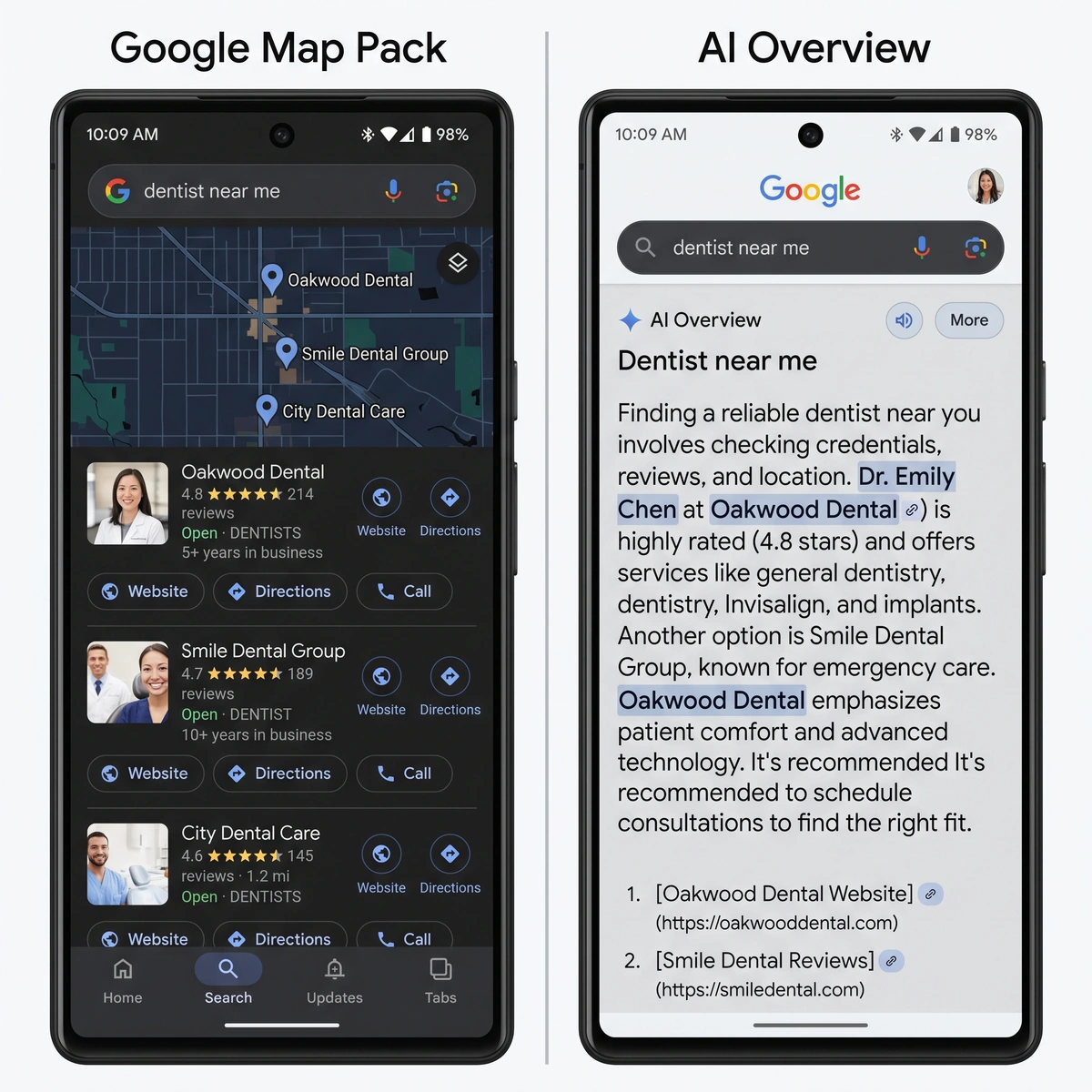
Local visibility. Most dental patients start with a local search, and the Google Map Pack (the top three listings with the map) collects the bulk of the clicks. A dental SEO company’s first job is getting you into that pack for the searches that matter in your city: optimizing your Google Business Profile, building consistent citations, and earning reviews. The review part matters more every year. BrightLocal’s 2026 consumer survey found 97% of consumers read reviews for local businesses, and 31% will only use a business rated 4.5 stars or higher, nearly double the share from the year before.
Site health and structure. Fast pages, clean mobile experience, structured data that tells search engines you’re a dental practice with these services at this location. We covered the foundations in our local SEO guide for dentists, and they haven’t changed: the technical layer decides whether the rest of the work compounds or leaks.
Content that answers patient questions. Service pages for every treatment you offer, plus content built around what patients actually ask: costs, pain, recovery, insurance. This is also exactly the content AI search engines cite, which we’ll get to.
Honest measurement. Calls, booked appointments, and direction requests, tracked in analytics accounts you can open yourself. Rankings are an input. New patients are the output. If a dental SEO company reports rankings without patient-level outcomes, you’re paying for a scoreboard, and the reporting might be hiding the real problem.
The AI Search Shift Most Dental SEO Companies Are Ignoring
Here’s the part that separates 2026 from 2022: your next patient might not scroll a results page at all. Google now attaches an AI-generated answer to roughly 16% of queries according to Semrush’s AI Overviews study, and patients increasingly ask ChatGPT or Perplexity things like “best dentist for implants near me” or “how much does a root canal cost in Tacoma.”
Those AI answers cite sources, and the sources are practices whose sites are structured for machines to read: clear schema, direct question-and-answer content, consistent business information everywhere. This is generative engine optimization, and almost no dental SEO company offers it seriously yet, which makes it the cheapest competitive edge available to a practice right now. Ask any provider you’re evaluating how they handle AI search visibility. A blank stare is an answer.
What Dental SEO Costs
Dental SEO retainers typically run from several hundred to a few thousand dollars a month depending on market competitiveness and scope, and our 2026 agency pricing guide breaks down the ranges in detail. Two pricing patterns deserve suspicion: the suspiciously cheap package (real local SEO takes sustained hours, and the math on a $199/month plan only works if nobody does the work) and the premium retainer justified by vague “proprietary technology” instead of deliverables you can list.
The bigger cost question is what happens to the work when you leave. Some dental SEO companies build your content on their platform, register your Google Business Profile under their account, or run tracking through dashboards only they control. That’s vendor lock-in, and it means firing them costs you your rankings. Everything an SEO company builds for your practice should live in accounts you own: domain, site, analytics, Business Profile, all of it.
Red Flags When Evaluating Dental SEO Companies
We hear the same stories from practices that come to us after a bad run. The warning signs are consistent:
- Guaranteed rankings. Nobody controls Google, and nobody controls what AI engines cite. A guarantee of “#1 in 90 days” tells you the company either doesn’t know better or hopes you don’t.
- No dental-specific results. Ask for examples from dental or at least local healthcare. Marketing a practice differs from marketing an online store, and the learning curve comes out of your retainer.
- They own your accounts. If the Business Profile, site, or analytics get registered under the agency, walking away means starting over.
- Reports without outcomes. Impressions and “visibility scores” without calls, appointment requests, and direction taps means the scoreboard is measuring the wrong game.
- One-channel thinking. A provider who only talks about blog posts, or only about the Map Pack, or has nothing to say about AI search, is selling the slice of the problem they happen to sell.
Want to know exactly where your practice shows up today, on the map, in classic search, and in AI answers? We'll run a free visibility audit for your practice and walk you through what we'd fix first. No retainer required, and everything we build belongs to you.
Get a Free Practice Visibility AuditQuestions to Ask Before You Sign
Take these into any sales call and the field sorts itself fast:
- “Which accounts will be registered under my practice, and which under your agency?” The only good answer is everything under you.
- “What does month three look like, specifically?” Real providers describe concrete deliverables, with owners and dates.
- “How do you measure new patients, and where do I see those numbers?” The answer should name your analytics and call tracking, in your accounts.
- “What’s your approach to AI search?” You’re listening for substance about structured data, citable content, and AI engine visibility, anything beyond a shrug.
- “Can you guarantee rankings?” The right answer is no. It’s the cheapest filter in the industry.
The Bottom Line
A good dental SEO company gets you into the Map Pack, builds content that patients and AI engines both trust, measures success in booked appointments, and hands you the keys to everything it builds. A bad one rents you a dashboard. The difference shows up within one contract cycle, so ask the uncomfortable questions before you sign instead of after.
Frequently Asked Questions
How do I choose a dental SEO company?
Look for dental or local healthcare case studies with real numbers, full ownership of your accounts (Google Business Profile, site, analytics all registered to your practice), reporting tied to calls and booked appointments rather than rankings alone, and a credible answer on AI search visibility. Then ask whether they guarantee rankings: a yes is a red flag, since nobody controls Google’s results.
How much does dental SEO cost?
Most practices pay somewhere between several hundred and a few thousand dollars per month, scaling with market competitiveness and the scope of work. Be wary at both extremes: ultra-cheap packages rarely include real work, and premium retainers should be justified by concrete deliverables rather than proprietary-sounding language. Project-based audits are a lower-risk way to evaluate a provider before committing to a retainer.
What should a dental SEO company deliver every month?
Expect ongoing Google Business Profile management and review strategy, technical site improvements, new or improved service and patient-question content, citation and listing consistency work, and a plain-language report tying it to calls, appointment requests, and direction taps. The report should pull from analytics accounts you can open yourself, not a dashboard only the agency controls.
Are dental SEO companies worth it for a small practice?
Usually yes, if the practice depends on local patients, because the Map Pack and local results are where new-patient searches concentrate, and most solo practices can’t sustain that work in-house. The exception is a practice already at capacity from referrals. The investment pays off fastest in competitive metros where page-one visibility translates directly into booked chairs.
Can a dental SEO company guarantee first-page rankings?
No. Google’s results and AI engines’ citations are decided by algorithms nobody outside those companies controls, and rankings shift constantly. Legitimate providers commit to process, deliverables, and measurable trends over time instead of guaranteed positions. Treat ranking guarantees as a sign to keep shopping.
Does AI search matter for dental practices yet?
Yes, and it’s early enough to be an advantage. Google attaches AI Overviews to a meaningful share of searches, and patients ask AI assistants for dentist recommendations and treatment-cost questions directly. Practices whose sites use clear structured data and direct question-and-answer content get cited in those answers, and very few dental SEO companies do this work today, which leaves the lane open.