Episode 440:54October 27, 2026

Christopher Woods Sr. on the crawl spaces other contractors won't touch

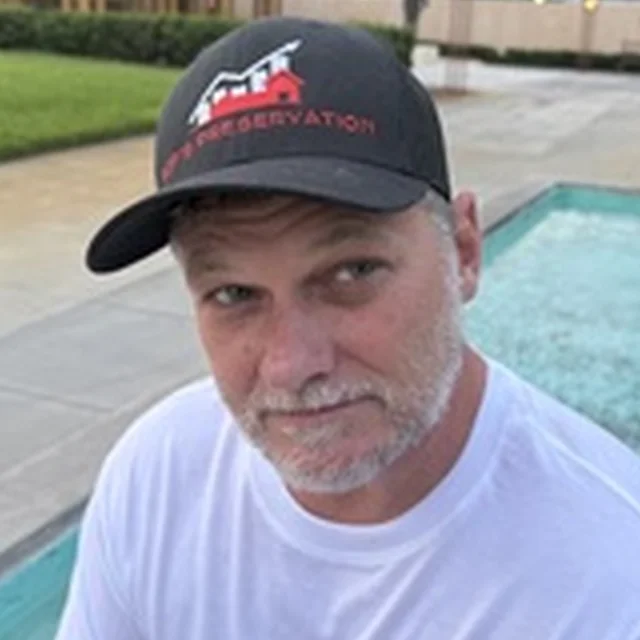
Christopher Woods Sr. spent 27 years in his family's industrial coatings business before starting Pop's Preservation in Lakeland, Florida in 2021. Chris explains why he takes the crawl-space jobs other contractors pass on, how he's earned 39 Google reviews that are all five stars, and why he's funding a local school's robotics team to build a camera car that can drive under houses.

Christopher Woods Sr.

Owner, Pop's Preservation · Lakeland, Florida

The short version.

  1. 01

    Take the jobs nobody wants

    Chris's rule: if a house has a crawl space, he'll work on it. Most people don't like working in crawl spaces, and the places other people don't want to go are where a lot of the profit is.

  2. 02

    Call everyone back

    A lot of the homeowners Chris talks to never heard back from the last contractor. He takes the smaller jobs others skip, because they keep the homes in his neighborhood in good shape and build his name in the community.

  3. 03

    Ask your carrier about robocalls

    Robocalls got so bad that Chris stopped answering and missed real customers. A Verizon add-on for about $25 a month now screens out the robocalls and AI calls.

  4. 04

    Grow slowly to protect the reviews

    Chris has 39 Google reviews, all five stars and all hard earned. He keeps his crews small and adds people slowly, so the quality doesn't slip as the business grows.

  5. 05

    Pick work a machine can't do

    When Chris left the family business, he chose work he didn't think AI could take over: getting under an old house, working out what it needs and doing the job.

A camera car for crawl spaces.

The project Chris has given a local school's robotics students, as he described it on the show.

Before

Crawling under a house to see what's down there

Now

A first look from a camera car before anyone goes under

  1. 1

    Hand the problem to students

    Chris asked the robotics department at McKeel Academy of Technology, a charter school in Lakeland, to design it as real-life curriculum. He's funding the project and gave them a budget.

  2. 2

    Set the requirements

    A radio-controlled car with a camera, lights and enough range to drive under a house.

  3. 3

    Make it hard to strand

    If it flips over, it still has to drive, so nobody has to crawl in after it.

  4. 4

    Look before crawling in

    The car takes the first videos and pictures, so Chris can see what a job needs before he goes under.

From steel bridges to old houses

Chris spent 27 years in his family’s industrial coatings business, Pop’s Painting, named for his grandfather: sandblasting, surface prep and protective coatings on work like the steel of the Bridge of Lions in St. Augustine. He did his graduate work in historic preservation, got his contractor’s license, and in 2021 started Pop’s Preservation in Lakeland, where he and his wife live in one of the city’s historic districts. The industrial background still shows. Where an old house seems held together by termites holding hands, he’ll run steel channel instead of wood, because steel won’t be eaten and won’t snap.

The jobs nobody else wants

Chris’s rule is simple: if it’s got a crawl space, he’ll work on your home. Most people don’t like crawl spaces, he’d much rather be in one than in an attic in the Florida sun, and the places other people don’t want to go are where a lot of the profit is. The same goes for smaller jobs. Many of the homeowners he talks to had a contractor who never called them back, and those jobs keep the homes in his neighborhood in good shape. A lot of those clients end up as friends.

Being reachable matters to him too. Robocalls got so bad that he stopped answering his phone and missed real customers, who probably thought he’d ghosted them. When he moved his phones to a Verizon business account, his rep pointed him to a call-screening add-on, and for about $25 a month the robocalls and AI calls went away.

Work a machine can’t do

When Chris left the family business, he chose work he didn’t think a machine could do: getting under an old house, working out what it needs and doing it. That doesn’t make him anti-technology. He’s funding the robotics department at McKeel Academy of Technology, a charter school in Lakeland, to build a radio-controlled car with a camera and lights that can drive under a house and keep going if it flips, so he can see what’s down there before he crawls in. Growth stays slow on purpose: the crews stay small and people own their work, because 39 five-star reviews are hard earned.

Chapters and transcript.

The full conversation, lightly edited for reading. Bracketed text marks a cut or an edit. Pick a chapter or a timestamp to jump there.

00:09

David V. Kimball

Welcome to Retooled, a show where we talk to business leaders about how they've equipped their organization to adapt to change over time. I'm your host, David. I'm joined by my co-host host here Dylan and we're here to talk to Chris Woods Sr. Chris is the owner of Pops Preservation based in Lakeland, Florida. Do you mind introducing yourself and kind of telling us who you are and how you got your start?

00:31

Christopher Woods Sr.

Yeah. Hi, I'm Chris. Thanks, David. Thanks, Dylan, for having me on your podcast today. I worked with my family in industrial manufacturing for 27 years then. It was in 2001 I decided it was time to go. So what I did is I did my graduate work in historic preservation and then got my contractor's license. My wife and I live in a historic district in Lakeland. We have several of them and a lot of historic homes. homes. Where we live at and so recognize the need for there to be a contractor to do the work on the kind of houses that we know we live in. We love our neighborhoods. We love our neighbors. So that's when, you know, I started doing this kind of work. And so as in 2021, so it's been five years now and things just continue to grow since then. So that's where I'm at now.

01:31

David V. Kimball

What makes working with historical homes different than just your standard modern build?

01:37

Christopher Woods Sr.

Oh, wow. You just run into some really interesting things. You know, you talk about peeling back layers of an onion and you really don't know what you're getting into sometimes. You might have an idea because you've seen things like this before. You just really see some interesting things. I just like the old houses. They tell a story, you know, and like I said, we're surrounded by them where we live and they just have a lot of character. character, um... They're just built differently, you know, and they've stood the test of time. And I think there's some proof in that and the craftsmanship and the materials used. used back then that they don't currently use and i think there's things worth uh worth saving there

02:27

David V. Kimball

what are some of the most unusual like buildings or structures you've encountered like what's one example

02:33

Christopher Woods Sr.

well i you know here's here's an example some of the things that they used to to um To fasten things together just really barbaric and archaic and in some instances you feel like it might just be termites holding hands together that hold the building together actually or some caulk or something and you're like wow man this really defies the laws of physics here and so you know with my I'm fortunate to have worked in the industrial manufacturing where I worked at because I can take some of that knowledge, you know, heavy duty type thinking and bring it into residential or commercial and really, you know, provide a cost effective but something solid solution, you know, for example, using using wood, if you need a fluorescent level instead of using wood as a, not a joist, but you know, that runs along the joist, you would, I'd use steel, you know, I use steel channel and run it all the way across because that, you know, that's not going to be destroyed by wood destroying organisms or, you know, it's not going to snap in half. So, I mean, that's just an example of some of the things that I do. And like I said, I was real fortunate to be, to have worked in the field that I worked in previously because I can bring some of that creative thinking because that's what I really do is I provide solutions for people like, you know, some people have been out here and they don't really know exactly what to do. So, I come, I come up with. One, two, three different ways to attack this, you know, and so that's something that I'm fortunate to have been raised and brought up in.

04:32

Dylan Baker

Nice. I did like a quick background check and I saw that you're the third generation running the business itself.

04:40

Christopher Woods Sr.

No, I'm not. I was third generation in where I was at before previously. Pop was actually my grandfather. That's what they called him. Pop's painting. I say industrial manufacturing, but we paint, basically sandblasting and painting, surface prep and industrial coatings. You know, we did things like, you know, bridge, steel bridges in knockdown before they went out into the field. The Bridge of Lions in St. Augustine, the rehab project on that, they, as a historic bridge, they cut it up into pieces. And they shipped a lot of it to either Florida Structural Steel or to our facilities. There's lead abatement and a lot of retro work on the steel rehab work and high-performance protective coating systems put on it. And that was a really neat project and I was glad to be a part of that. So it wasn't just like widgets. It's a job shop and we did like really, really big things. Nice. So but I'm the first one in this business and I was third in that that business.

05:47

Dylan Baker

Yeah. And you went to school at Kentucky University. Is that is that correct?

05:52

Christopher Woods Sr.

Yeah, I did. I did my undergrad at University of Florida and did my graduate work at University of Kentucky.

06:00

Dylan Baker

How did you like living in Kentucky? I grew up in Ohio, so I like to talk to people about Kentucky because I think it's pretty underrated as a state.

06:08

Christopher Woods Sr.

I'm sure Kentucky's a really nice state. I've never been there before. Everything I've done is online. But, you know, to all the bluegrass people out there, you know, God bless you. You know, I really had a good experience at University of Kentucky. And perhaps one day I will go there, but not yet.

06:26

Dylan Baker

Nice. Awesome.

06:29

David V. Kimball

Yeah.

06:30

Dylan Baker

Go ahead, David.

06:32

David V. Kimball

Oh, go for it.

06:34

Dylan Baker

Oh, I was going to say, Chris, so, you know, one of the things we like to talk to business owners about on the podcast is like their day to day kind of like tool technology stack. Do you have any favorite softwares that you're using on a day to day basis or any like tools that you're using on the job site?

06:52

Christopher Woods Sr.

I, I, I don't. Technology is really something I'm interested in and I've looked a lot into. And I'll give you an example. A couple of weekends ago, my wife and I went to Kansas City because they have these lasers that strip paint off. Things now and clean concrete, no clean steel. But I wanted to try one of these before I invested that kind of money in in in this in a piece of equipment. And I'm glad I did, because what I discovered was the lasers don't like white paint. All right. And a lot of the I was thinking specifically like the windows sashes that we do and things like that where they need to have the paint stripped off. A lot of them are white paint. Paint and the laser really heats up the wood underneath it so there's some on the example that i had there's a lot of charring and stuff so i mean i'm looking at different ways that i can use different equipment um to uh you know bring into my arsenal of tools uh but as far as um software and stuff um i actually put on somebody putting on somebody today that a bookkeeper i'm just used i want to use some of the softwares that are available to me uh you know i mean everybody uses chat gpt or something like that to some degree but as far as uh using any software or anything i really don't really haven't really ventured into that yet but i'm excited to do that sometime soon thanks

08:23

David V. Kimball

that's all right i mean one of the things that you said was you started you said 2021 right yeah yeah so that was like just post pandemic basically uh did you find that like that affected the business in a way you didn't expect were you like were you already ahead of it by the time you started

08:40

Christopher Woods Sr.

no uh it it doesn't matter what people do they have to have their house livable so um code or no covid home repairs were needing to be done and there wasn't a whole lot of new construction or additions at the time but home repairs that's Basically, I was doing, as a contractor with, you know, doing handyman work at that time. So, the contractor's license just lent me credibility, so, but as I've grown and progressed, you know, I've been able to get into more complex things, so.

09:15

David V. Kimball

That's great. And you mentioned that you don't do a whole lot with, like, software right now. Is that just, like, the job, the nature of the jobs you do doesn't require it? Or is it because, like, it's not an area you're comfortable with, but, like, you're, like, curious about?

09:28

Christopher Woods Sr.

No, I'm really curious about it. And it's not that I'm uncomfortable with it. It's the scale at which I'm at right now. I just don't see a good fit for it. But I'm going through a phase where I'm starting to expand a little bit. And it might come more into play. But when it's just me and a few guys, I just I don't see the need for anything as of right now, but I do see that in the future where it's definitely going to not just be a possibility, but a requirement.

10:00

David V. Kimball

Right. Totally. So if it's you and a couple guys, I'm assuming you leverage partners and vendors and things. Is there anyone that you've worked with recently that you like want to give a shout out to that you thought, man, they did such a good job. They were so helpful.

10:15

Christopher Woods Sr.

Brian and Roxy, you know, they're great. It's a husband and wife and he's, he's, they just do some really good work. The guy that came in just a little while ago, Marshall, he does a lot of tile work and he's, he's really awesome. And I always tend to get him right at the right time when he's not busy, you know, so that works out really nicely for both of us. Um, give a shout out to Rob, you know, works with me. He's been there almost from the start. And then my, my youngest son works with me full time. And what a treat that is, you know, to be able to work with your, your child every day and be able to take a lot of your experience and pass it on to him. And, you know, Having those boundaries with the family and the work, it hasn't been hard because I've lived the dysfunction in the work that I did previously and the approach that I take is much different than what my father had, my father and I. But it really is a treat to be able to work with my son every day.

11:18

David V. Kimball

Can you say more about that? Because I know there's a lot of conflicting takes and information, not just with working with family, but also working with friends. So, let's You know, for example, they say, oh, yeah, if you want to ruin your friendship, start a company with a friend or something like that. Or they say, you know, if you work with your spouse, that's like the biggest mistake ever. You mentioned that couple that you really like. And I'm seeing lots of examples where that's not the case. Is it just about setting really good boundaries or you said you do things differently than how you and your father work? So can you explain that a little bit more?

11:51

Christopher Woods Sr.

Well, I think it's a little bit of both. It's a little bit of having the experience and being able to recognize and be aware, you know, of some of the things that are going on. And the boundaries are important, too. I just recently bought a shop where I can do a lot of my work at. So it's nice now that I can leave work and go home because my office was it was in my backyard. And, you know, My wife was a professor at USF and during COVID, I built an office for her that, you know, I had a desk at, but now I can actually leave my work at work and go home. And that's real nice. And, you know, as far as friends and family working with you, sometimes... You know, they think, oh, it's just your dad, you know, you don't know what the hell he's doing. But you give room for, let him make those little mistakes where you see it's not gonna be detrimental to the job, you know, let him discover those things on their own, because you can tell somebody something all day long, but until they see it for themselves, they just don't really. You know, take grasp of the concept, you know, hey, I'm about to screw something up here, or maybe that was right. So letting people learn those lessons on their own when you can, you know, is really better for everyone. And then it builds a little bit more trust, you know.

13:24

David V. Kimball

Yeah, yeah, kind of like an evergreen parenting principle, which is you got to let your kids learn the hard way sometimes to really learn the lesson. You have all the wisdom, and that's what's painful about being a father sometimes. I have very young children, so I can't say I've imparted much knowledge to them yet. They just repeat whatever I say, which doesn't really count. But that principle of, yes, I have this wealth of knowledge. I've gone through what you've gone through. But it doesn't matter how much I tell you. You're not going to actually like synthesize the information until you make the mistake yourself or you struggle yourself through it, which is painful to watch, but it's also just part of reality.

14:02

Christopher Woods Sr.

Yeah, it is. It's not that painful to watch because you don't want to put them in a necessarily dangerous situation. You know what I mean? But you got to let people make mistakes, you know, and learn from them. You know, this is just lip service, you know, it's just got, they got to see the action for themselves and learn, learn the mistakes the hard way. But, you know, like I said earlier, that builds some trust. So then later on, I mean, hey, maybe he does know what the hell he's talking about. You know what I mean?

14:34

Dylan Baker

Definitely. Well, it seems it seems that things are going well, if you're planning on expanding the business. Would you say there was ever a time from, you know, when you started? 2021 until now that things like got bad and you thought about giving up, but you just kept moving forward?

14:52

Christopher Woods Sr.

No, I giving up is not my vocabulary. You know, if it's not necessarily I want to bend the universe to my will. OK, but I accept things. But I also accept that I want to succeed at this. And so you get out of it what you put into it. Yeah, there's some late nights that you stay up till the morning and you're doing your quotes or your bookkeeping or something. But, you know, perseverance is the grit. It's just my last name is Woods and it's built into me and that's it's in my blood. So if I want to make it, I'm going to make it. I don't want to make it, then I won't. But I'm going to make it.

15:34

Dylan Baker

There is no plan B, right?

15:36

Christopher Woods Sr.

No.

15:37

Dylan Baker

There's only plan A.

15:38

Christopher Woods Sr.

No. Well, the wife and I, we've got some rental, some historic home like apartments and some other revenue streams, but there is no other plan. There is no plan B. This is it.

15:48

Dylan Baker

I love it. Okay. So we've talked to some other business owners over the past few weeks while we've been recording the episodes. Has there been like a nightmare scenario that you had to navigate with one of these historic? Properties that you ended up, you know, overcoming it and going above and beyond for the client?

16:10

Christopher Woods Sr.

No, I wouldn't say specifically, but what I have found is when doing the industrial work, it's like, here's the spec, do the work. You do your QC and your documentation along and you send the documentation along with it out, the semi goes to the job, it's done. People are real sentimental about their homes, especially their historic homes. problems. so so So you get a different each each person is different. It's not like here's a here's a spec, do the job. But everybody's got their own biases or flavors that they like. But going above and beyond, that's that's just the nature of what I've always done. You know, it doesn't cost that much for me to stay and do this little thing or whatever to make them happy. And, you know, that's the difference between having somebody upset and making them happy. I know they're going to pay anyways, but I live and die by Google reviews, as a lot of businesses do. And I'm proud of the 39 that I have so far, and they're all five stars and they're all hard earned. So, at the end of the day, I'm not trying to make money, knock it out of the park, but I try to give people what they want and then the reward for that is you make some money. And that's the way I approach it.

17:39

David V. Kimball

That's great. I'd love to talk to you more about the Google review stuff in a second, but before I do that... You're on the east coast. You're in Florida. So historical homes mean something different than us. I'm on the west coast. And so you guys have much older buildings over there. So what is like the actual range of like the ages that you've worked with, like from the older to like the more modern, I guess you could say, of the historical side of it?

18:07

Christopher Woods Sr.

I think the oldest one I worked on is probably a 1915 home. Um, and then, like, Our home was built in 1959 and I love it. it, it's, um, it's, it's, it's... Here's what my general rule with them is, if it's got a crawl space, I'll work on your home. Nice. nice uh So, that's the general rule. Because what I've found is, well, going back to your question, you know, up into the, like, the 1960s. But what I've found is people don't like to work in crawl spaces. I love crawl spaces. I'd much rather be in a crawl space than an attic in the Florida sun. time. And that's where a lot of the profit is, is, you know, the places that other people don't really want to go. So, um, no, if it's got a crawl space, I love it. I'll jump in there all day long.

18:58

David V. Kimball

Can you attribute that to some of the, I mean, obviously it seems like you really put the good job first and that's why you have good reviews. But do you anticipate that like one reason that you've had such success with your reviews is that people are like, finally, somebody wants to do it?

19:15

Christopher Woods Sr.

I think in some cases, yeah. Yeah. Yeah. I've gone to a lot of places where people, they've had contractors out or they, you wouldn't believe the number of people I talked to that the contractor just doesn't even return a phone call. That, I cannot believe how often that happens and that just blows my mind how you wouldn't at least talk, call the customer back and say, you know, I'm not interested or that's not really in my scope of work. But, you know. For the people that I do get to talk to, they might have had people come out or called people, but they just don't bid the job or something, you know, because I guess they don't like crawl spaces. I don't know.

19:58

David V. Kimball

It's crazy, Chris. This is not the first time we've had someone on the show to say, yeah, I give someone else a quote and they're just like, thank you for not ghosting me. Apparently, this is like a really big problem in the industry.

20:11

Christopher Woods Sr.

It is. I can't believe it. It really blows my mind. If you're a new builder, building new homes, custom homes, you're going to call those people back, I guess. But it's the smaller jobs. Nobody else wants. Well, those are the jobs that I do want to take because those are going to help keep the value of the homes in my neighborhood up and help. You know, maintain a good relationship in the community, you know, and so that's what I've done basically is I've built a lot of clients through my community and the greater area. And a lot of times we become friends in the end, you know, so I've been really blessed. But it's crazy the amount of people they just ghost or don't turn the phone call. It's crazy. I don't know how people stay in business like that, to be honest with you.

21:06

Dylan Baker

Would you say that a majority of your inbound leads come in via phone call or do you have a form on your website? site or uh Where is it all funneling in from?

21:20

Christopher Woods Sr.

I get a phone call or a text or an email. Sometimes I get Facebook message. And you know what? I really need. I'm glad you brought that up because I do have a preferred way. I prefer a text or a phone call initially. The robocalls. I finally got a way to screen the robocalls and get those out because I did. I missed some customers. I quit answering my phone for a while because of the robocalls. calls and then I just go through the messages and I did I missed a few customers and they probably think I ghosted them which I I didn't but when you realize it's two weeks after they called you you know how do you explain that so I kind of I kind of regretted some some of those instances and I that's where some of the technology comes in as you talk to your vendors I talk to Verizon and they have this thing that'll screen your your phone calls so that is one area that's helped me a little bit And I wouldn't have known that unless I changed my phones over to a business account and talked to my sales rep about that. So technology has helped me in that regard, you know, get rid of the robo calls or at least screen them and reject them. And I can get to the real phone calls that are actually some business, you know.

22:35

David V. Kimball

Okay. So for other businesses that are getting bombarded with like these robot calls or AI calls, you're saying if you switch to a specific business plan with your provider, you can actually get it to where those things are automatically filtered out?

22:47

Christopher Woods Sr.

Yeah. Yeah. Verizon actually has one. I forget what it's called, but it's like $25 a month or something like that.

22:53

David V. Kimball

I wonder if that service. Sorry, go ahead.

22:56

Christopher Woods Sr.

I was going to get one of those concierge people or, you know, it's a person that answers the phone call. And it's but I didn't want to spend that much money on it. it because it was quite a bit of money so you know for 25 bucks a month the the robo calls and AI calls they they've gone away okay

23:14

David V. Kimball

I was gonna ask you if it also took care of the AI calls because those are getting pretty convincing so I'm curious how that works under the hood a little bit but maybe that's outside of the scope of this this pod so you said you preferred getting texts and phone calls why is that why is that your bias is it because it's on your person it's like the most convenient or is there another reason

23:32

Christopher Woods Sr.

no I think it's a little more personal you know It's a little more personal than an email or a message, you know, which does eventually turn into a phone call or a text, you know. I want people to hear my voice and hear that I'm sincere about, you know, I do want to meet them. I do want to look at their job. I'd be happy to meet them and accommodate, you know, whenever their time is. It's crazy these days. Business hours used to be, you know, eight to five or something. Now it's, um, uh... And, you know, part of this is boundaries, too, but I want people to I don't want to be so firm in my boundaries to where, you know, do not call me after five. You know, I might not answer it after five, but it's almost like people expect you to be on demand it like whenever now that they can get a hold of you. But I do try to. Give the name Pop's Preservation and personality. So that's why I want that initial phone call or that text.

24:32

Dylan Baker

So you said you're like immediate teams pretty small, right? Around four or five people?

24:39

Christopher Woods Sr.

Yeah, right now I have, I just have two guys and myself. If it's up to me, I just work and do sales calls, you know, but I'm phasing some of that stuff out. And I do use some subcontractors sometimes.

24:55

Dylan Baker

That was my next question I was going to get to. You're kind of hands-on right now. What responsibilities are you taking on on the job sites and stuff right now? Are you doing a little bit of everything or is there stuff you prefer over the other?

25:11

Christopher Woods Sr.

No, like I said, if I could, I'd just do sales and do the hands-on work. I prefer to do hands-on work. I don't mind sweating. So, I'm just setting in a... You know, bending over and lifting things. My happy place is on a piece of equipment, but I can't do that all the time. But, you know, I keep my my crews small, you know, and I see some leadership. I'm fixing to put on another person full time and I'll get it. I'll get a work truck here, another one in the future. And I want to keep it small, control growth instead of getting too big too quickly because there's five star reviews are hard earned. And I feel like if you let you get too big too quickly, and I don't micromanage, I don't do that. I let people own their job. But I don't want the level of quality to go down either. So for me to just turn you loose, there's got to be that level of trust, you know, and I got to work with you for for a while before I can trust you just to be able to go out and do that on you.

26:15

David V. Kimball

Along those lines, have you had trouble delegating in the past or do you anticipate delegation being an issue? Because I know you said you don't micromanage, which is a relief to any future prospect hire that you might have. But also, you don't want to betray the quality and like like like it or not, no one in your organization is going to care as much about your organization as you are. You know, so how do you how do you decide who did how and who did to delegate and what?

26:44

Christopher Woods Sr.

Well, you just you just know your people and you know their skill set. So, you know, if they're they might be lacking a little bit in this area, you might have to stay there with them a little bit longer until you feel a little more comfortable. And some things you can just give them the work order and say, here, go take care of this, you know, because you have confidence in their skill set. So, it's getting to know your people, you know, and, you know, if I grew to the size of 20 or 50 people, I want to know all my people, you know, and I want to know who they are and I want to know what they're about and I want to know what they're capable of and I want to put the right person in the right. right uh in the right scope of work where they where they can do the best work they can do you know yeah

27:31

Dylan Baker

for sure totally man so you grew up in florida chris

27:42

Christopher Woods Sr.

i am i am um I'm a redneck. neck um Yeah, I'm a Florida guy. My family's from Florida, lived in Florida my whole life. Even when I went to school at UF, lived in Lakeland most all my life. When I was in Gainesville, much of that I drove back and forth to go to school. You know, so, um, yeah, Florida, it's, it's all I, although Kansas City is real nice. If I had to move one place in Kansas City would be at the top, top of my list, probably. But it gets hot in Florida, man. It gets, it's, um, it's no joke with the humidity, especially when there's no wind. So, but Florida's, Florida's hot. I think it always will be as far as construction goes. There's a lot of historic homes here. So I feel like there's always going to be some work for me.

28:39

Dylan Baker

Do you ever work on like the French style, like wraparound porch type houses? Or like what are the historic houses like in Florida and like the neighborhoods you're working in currently?

28:52

Christopher Woods Sr.

A lot of them are the Craftsman Bungalow houses. You know, the old Sears catalog. You'd order the bungalow and they deliver it with a horse and buggy. And interestingly enough, I don't know if you guys are architecture fans, but Frank Lloyd Wright, the largest collection of his work is two houses. or you know one street from where I live, Florida Southern College. He designed and built a lot of those buildings there. And I've been trying for a while to get my foot in the door there, but I haven't successfully done that yet. But I can't wait till I do. So, I do… But if you really want a treat, man, you come to Lakeland and go visit Florida Southern College and you'll really see some really cool architecture. Um, But to answer your question, I see a lot of the bungalows, you know, that's. That's what I work with.

29:48

Dylan Baker

Those are like ranch-style houses, right?

29:50

Christopher Woods Sr.

No, they're – I wouldn't call them ranch-style. It's mail-order house, man, and they would install the wood and ship it to you, and, you know, you would build it. I guess you get an instruction book, I guess, and then you'd be like, you know, put it together like an Ikea table but on a larger scale, you know? Wow.

30:16

David V. Kimball

Yeah. What's like the toughest job that you've had that you can think of? Maybe not ever, but like recently, what's like been a tougher job for you?

30:26

Christopher Woods Sr.

One that involved a crawl space, I was real sure. There's crawl spaces that are like this, and, you know, I've put on a few pounds over the last few years, so working in some of those crawl spaces, I don't know. I'm speaking I'm thinking of one house in particular recently and my son is a little guy so he's easy to send up under there but he just couldn't quite figure this one out and so I had to get my get my fat ass under there to get my hand and talking about technology again So I've partnered with a, it's not a charter. Yeah, it is a charter school, but it's called McKeel Academy of Technology here in Lakeland. They have a robotics department there. And I know there's some available on the market, but what I've tasked them with, and I'll fund the project, but I thought it'd be neat to give them some real life curriculum. I want them to build me a radio controlled controlled. Car that will go under a house and, you know, take videos and pictures for me. So initially, I don't have to go up under there and see things. But, you know, this this car will for me, you know. So I've asked him to do, you know, has to have camera lights, a certain range. And if it flips over something, you know, it's still got to be drivable, whether it's on one side or the other. So I don't have to go under and retrieve it. So. That's another area of technology that I just thought about, I didn't think about earlier. So they should be coming to me soon with some ideas and a request for funding. But, you know, I've given them a budget to work with. So that should be interesting to see what they come up with. That's really cool. That's awesome.

32:16

David V. Kimball

Yeah, robots are like, man, the next frontier, I think.

32:20

Christopher Woods Sr.

They are. And there's this fear that AI is going to take over all the work that we do. Just like. Computers were going to or, you know, I don't know where that's going to lead. But I do know. I do believe that there's some things that AI or AI controlled things will not be able to do. So I was considering that when I decided what I was going to do when I left the family business. I'm like, what can I do that? that You know, some machine probably will not be able to do, you know what I mean? And that's problem solving and actually get and actually do the work. You know what I mean? Yes. Yes. So, So, you know, everybody fears this AI. Like I said, I don't know what's going to happen, but I think there will still be work for. For what I do, there will be some work out there for us.

33:18

David V. Kimball

Yeah, so about a year ago, I want to say, Microsoft released a study that listed the 40 jobs most at risk of being replaced by AI and 40 jobs least likely to be replaced by AI. And under the least likely, the bottom 40 were automotive glass installers, bridge and lock tenders, cement masons, dishwashers, dredge operators. And it goes down to like water treatment plants, tire builders, roofers. So, the kind of things that are at least tangential to your work, if not just your work outright, they identified as the bottom 40 occupations with the lowest AI applicability score.

33:57

Christopher Woods Sr.

Well, that's comforting to know. So, that kind of confirms my suspicions, you know? But I knew that anyway. There's some things that a machine just can't do, you know? And that's . . . You know, get in there and look at it and say, hey, what what needs to be done here? What's the most practical thing to do or how how can I make this last and actually get in there and do it? You know, it might be one day, but I don't think it'll be in my working lifetime. I hope not. I mean, that would not be good.

34:32

Dylan Baker

But I think you're I think you're in a good spot right now. I don't I don't think. I don't think AI is going to be working on the foundation of historical houses in the crawl spaces.

34:42

Christopher Woods Sr.

No, you know, I've seen some interesting things where AI is in construction and they are doing foundations, but this is all new construction. You know what I mean? It is where I've seen some of that technology used, but not in the historic home stuff, you know. Know, new construction, it may pose a threat. I don't know, but at least in the work that I do, it's farther out anyways.

35:07

David V. Kimball

With AI, we know giving it context and reference points is how it's effective. So if you have a blueprint, you have, hey, here's a 3D model skew of the thing that's in front of you. It's far more effective. If you give it a... A historical building that has no blueprint and no, you know, there's, it was chiseled from just anything they had or whatever. It's not going to do a very good job, at least right now. It would have to be going on the fly and making all kinds of estimations, which a human is far more capable of doing right now. So to your point, I think the context. Is the biggest gap right now, by far.

35:48

Christopher Woods Sr.

Yeah, I think so. Cool. Well, I think I'm safe for a while anyways. Yeah.

35:53

David V. Kimball

Yeah, Chris. So we're wrapping up. We're almost at time. I would love to know, Dylan, do you have any other questions for Chris or, you know, Chris, do you have anything else you want? Anyone else you want to shout out or any other points you want to bring up before we close?

36:06

Christopher Woods Sr.

No, I'd like to give a shout out to my dad because I did learn a lot of things from him, even though in the end we weren't able to work together. But, you know, we still have a good relationship and he did teach me a lot of things, business, work ethics and things like that. So... Hopefully that, and my oldest son actually works there where I used to work now. So we're still all in the family and the Pop's name has, it's a handshake deal, man. If Pop says he's going to do it, you know, it's going to be done, you know, and it's going to be done to the best of his ability. And we're going to try to make you happy. So that's a family tradition and that's passed down generations. So that's one thing I'm proud of. So shout out to dad for that. Epic. Love it. And also my wife, my her unwavering support and love to see me through some challenging times. I couldn't have. I couldn't have done it without her, you know. So shout out to Miss Lindsey. And she's just the best wife anybody could ask for. I could ask for. She's been awesome, you know. Yeah. Good stuff. Yeah.

37:30

Dylan Baker

David, I'm all good on my end.

37:32

David V. Kimball

Okay, I guess I have one more question. What do you love the most about being a redneck? neck

37:37

Christopher Woods Sr.

Ha ha ha ha ha! Oh, Lord. Well, I'm not your... You're, you're, uh... You're ordinary, everyday redneck, but I like driving a big truck. It gets 9.1 miles to the gallon in my F-350 Dually, you know, the diesel in it. You know, I don't drink or anything like that. I'm sure I have some guns, but I don't have an arsenal. You know, I don't hunt. I don't fish. In fact, I don't know if this is appropriate or not, but I even lean a little left in my politics. You know what I mean? But, you know, we all live together in a community. And so bringing that community together is really, is really nice. And it doesn't matter which side of the aisle you're on, left, right, middle, whatever. Your sexual orientation, whatever. We all live together, you know, and we've all got to find something in common so we can all get along, you know. And so as a person, I enjoy being able to bring people together sometimes so we can find a common goal, you know. I do.

38:53

David V. Kimball

It's funny that that perception of where you stand and what makes you redneck or not would be so different on the East Coast, Pacific Northwest versus where you are. You know, like if we were to take what you outline and put you in the middle of my state, you'd be like, oh yeah, you're a total redneck. No disclaimers needed.

39:13

Christopher Woods Sr.

It is. You know, my wife and I, on our honeymoon, we were in Paris. And I said, I need to try to fit in a little bit better, you know, or dress. She said, Chris, it doesn't matter where you travel. You're always going to look like a Dale Earnhardt fan. (laughter) Rest in peace, Dale.

39:32

David V. Kimball

Well, there you have it.

39:34

Christopher Woods Sr.

What state are you from, David? David, where were you at?

39:36

David V. Kimball

Washington State.

39:38

Christopher Woods Sr.

Oh, I'd love to get up there sometime.

39:40

David V. Kimball

Hey, if you ever visit, let me know. Love to treat you and your wife if she gets to go as well.

39:45

Christopher Woods Sr.

That'd be great. Yeah, thanks. How about you, Dylan? Where are you out of?

39:48

Dylan Baker

Uh, well, I mean, I, I grew up in Ohio, like I said, but I, but I lived in Seattle for a really long time. But right now I'm living, I'm living abroad. I live in Thailand right now. But

39:58

Christopher Woods Sr.

oh, nice. Yeah, yeah. Well, I love Thai food. Thai is one of my favorite foods to eat. And shout out to Washington because Nirvana is my favorite band. Nice. Cool.

40:11

David V. Kimball

Epic. Love it. Seattle. All right, Chris. Well, thanks so much for your time. It was a pleasure to talk to you. If people want to find you or do business with you, I'm not sure if saying a phone number on a podcast is a good idea. Maybe they could find your website, find your phone number from there. Where's the best place to reach you?

40:28

Christopher Woods Sr.

you uh pops first Pop'sPreservation.com.

40:32

David V. Kimball

Great. Yeah. All right.

40:35

Christopher Woods Sr.

Take it easy, everyone.

40:36

David V. Kimball

All right. Thanks. Bye. Bye.

What came up.

The tools Christopher mentioned on the show. We don't take money from any of them.

Verizon call screeningScreens out robocalls and AI calls on his business lines, for about $25 a month
Google reviewsWhat he says he lives and dies by
McKeel Academy of Technology roboticsBuilding the crawl-space camera car he's funding
GET STARTED

Find out what you could stop doing.

We take the repetitive work that eats your week and automate as much of it as we can, so you can spend your time on meaningful work that moves the business forward.

Smiling woman holding a smartphone at the center with orbiting logos of programming languages and platforms including Swift, Ok.ru, and others.