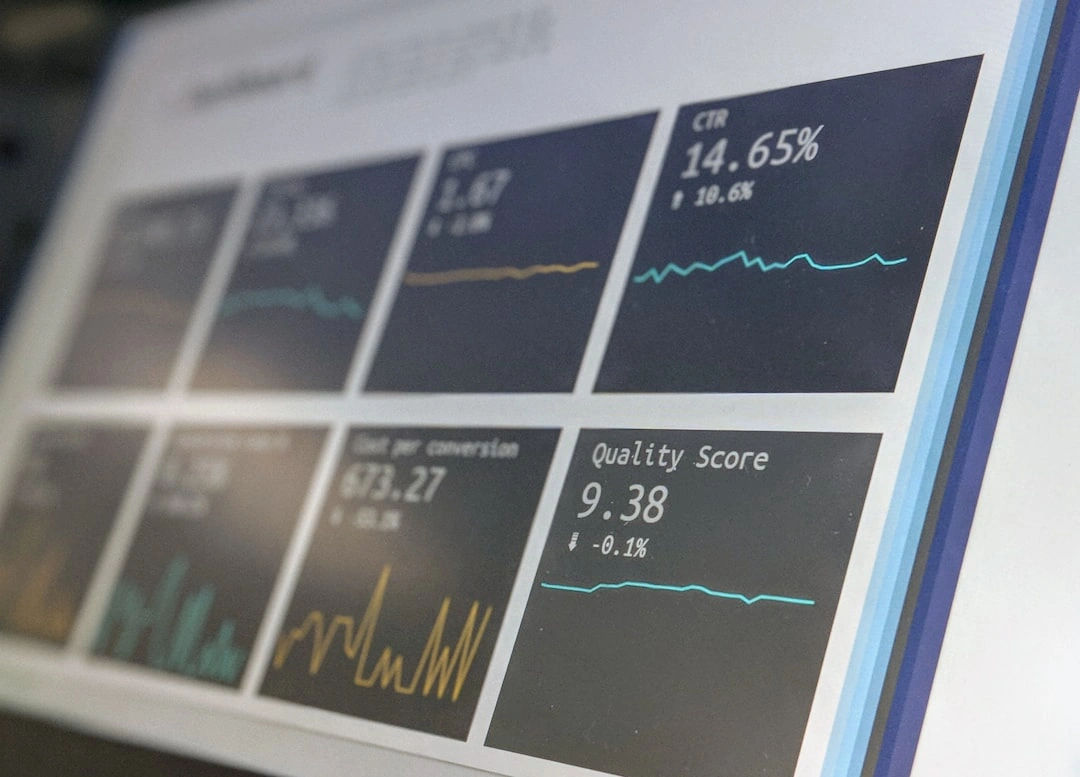
How To Calculate Marketing ROI
If you’ve been following our content or working with us, you know we’re all about cutting through the fluff in marketing. Over 15+ years in this game, spanning marketing, design, and software dev, we’ve seen a ton of businesses struggle with one core thing: figuring out what’s actually working in their marketing efforts. We get asked about this all the time, whether you’re running your own campaigns, overseeing a marketing department, or partnering with an agency like ours. People want to know: what metrics should I be tracking? How do I extract real insights? And why does it feel like I’m drowning in data but still flying blind?
We recently put together a video to illustrate this, and it sparked a lot of great conversations. Let’s break it down step by step, and by the end, you’ll have a blueprint for building your own measurement system that ties directly to your bottom line.
The Big Problem: You’re Probably Measuring the Wrong Stuff (And How to Fix It)
First off, let’s address the elephant in the room. Most folks we talk to are measuring the wrong things. It’s not their fault; marketing platforms love to shove vanity metrics in your face like impressions, clicks, and likes because they make everything look shiny. But those don’t tell you squat about whether your efforts are paying off.
Why does this happen? Two main reasons:
- You Don’t Know What to Measure: If you’re new to this or stretched thin, it’s easy to default to what’s easy. Google Ads shows you click-through rates (CTR)? Cool, track that. Facebook gives engagement stats? Must be important, right? Wrong. These are surface-level. They might indicate interest, but they don’t connect to revenue or growth.
- You Lack the Capacity: Even if you know better, setting up proper tracking is a pain. You need tools that talk to each other: end-to-end attribution that follows a user from first ad click to final purchase. Without it, you’re piecing together puzzles from different boxes. For example, if you’re running Google Ads and only looking at their dashboard, you’re missing how those leads interact with your email nurture sequence or organic content.
The fix? Shift your mindset to outcome-focused metrics. Think about your business goals first. Are you an e-commerce store chasing sales? A SaaS company hunting subscriptions? A service business after qualified leads? Your key performance indicators (KPIs) should ladder up to those. In our video, we used a dummy dashboard for an e-com setup, but the principles apply everywhere. Let’s start with the fundamentals.
Core Metrics: The Top-Line Stuff That Actually Matters
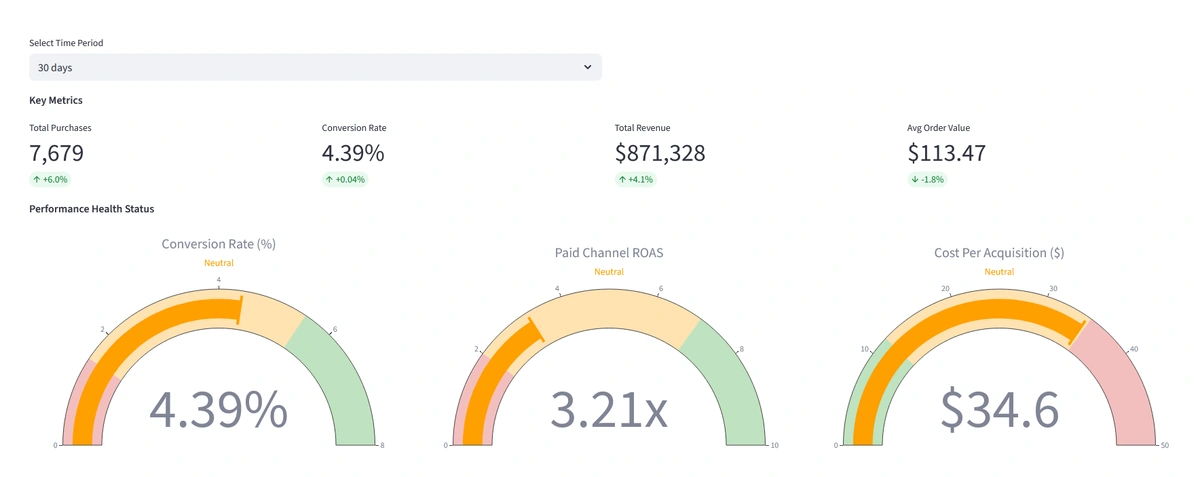
At the highest level, your dashboard should give you an at-a-glance view of health. Here’s what we recommend prioritizing; tailor these to your biz, but don’t overcomplicate it.
- Number of Conversions: This is your North Star. For e-com, it’s purchases. For lead-gen, it’s form submissions or booked calls. Track total volume over a set period (e.g., last 30 days, quarter-to-date). Why? Volume shows scale; if it’s flatlining while spend increases, something’s broken.
- Conversion Rate: Percentage of visitors or leads that turn into paying customers. Aim high; industry benchmarks vary, but for paid traffic, 2-5% is common; organic might be higher. In the dummy dash, we targeted 6%+. Low rates scream issues like poor landing pages or mismatched targeting.
- Total Revenue: Raw dollars generated. Break it down by channel to see who’s pulling weight. Don’t just celebrate big numbers; contextualize with costs.
- Average Order Value (AOV): Revenue divided by conversions. Boost this with upsells, bundles, or better customer segmentation. If AOV drops, investigate pricing or product mix.
Then, layer in efficiency metrics:
- Cost Per Acquisition (CPA): How much to acquire one customer/lead. Target: As low as possible without sacrificing quality. In the video example, we aimed under $35. If it’s creeping up, pause and diagnose; maybe ad fatigue or rising competition.
- Return on Ad Spend (ROAS): Revenue divided by ad spend. For paid channels, shoot for 4-7x+ depending on margins. Anything under 2x? Red flag; you’re losing money.
These are your business’ vital signs. Use gauges or color-coding (green for good, red for critical) to make them visual. Pro tip: Set benchmarks based on historical data or industry standards, but adjust for your reality. A startup might tolerate higher CPA for growth; a mature biz wants efficiency. Having a single source of truth for your data makes this analysis much more reliable.
Drilling Down: Channel-Specific Performance and Insights
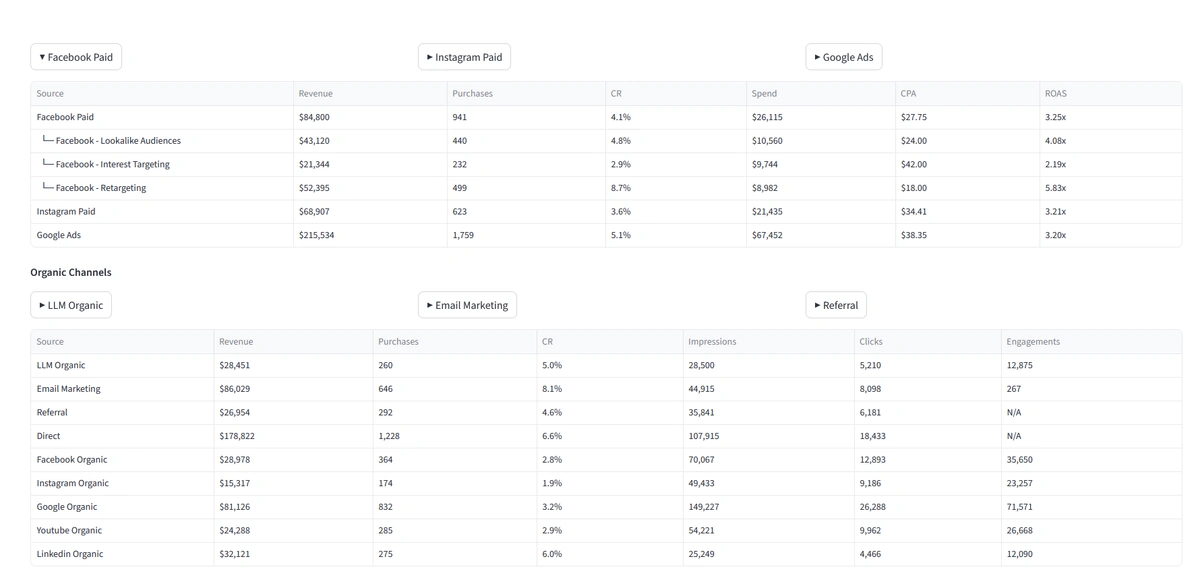
Once you’ve got the big picture, zoom in. This is where most dashboards fall short: they either lump everything together or are too granular. You can break it out by paid vs. organic, then by platform.
Paid Channels: Where the Money’s at Stake
Paid ads (Facebook, Instagram, Google, etc.) are easy to track but tricky to optimize without depth. In the video, for example, we expanded on Facebook Paid: Overall ROAS was 3.38x, but drilling down showed:
- Lookalike Audiences: Crushing it at 4x+ ROAS. These use your best customers to find similar folks; double down here.
- Interest Targeting: Lagging at half that. Maybe the interests are too broad; test narrowing them.
- Retargeting: Best performer. Warm audiences convert better; allocate more budget.
Do this for every campaign. Look at spend, impressions, clicks, but always tie back to conversions and revenue. Best practice: Use UTM parameters for tracking. Tools like Google Analytics or Mixpanel can attribute properly, showing multi-touch journeys (e.g., Facebook ad > email click > purchase).
For Google Ads: Focus on search vs. display. Search often has higher intent, so expect better conversion rates. Instagram? Visual-heavy, so test creatives rigorously.
In-depth tip on attribution: Default to last-click (credits the final touchpoint), but that’s flawed; it ignores upper-funnel awareness. Switch to data-driven attribution in Google Analytics, which uses machine learning to weigh each touch. If you’re on Facebook, enable their pixel for cross-device tracking. Without this, you’re undervaluing channels like display ads that build awareness.
Organic Channels: The Long Game
Organic is squishier; no direct spend, but massive potential. Track referrals from:
- Search engines (Google organic, Bing organic)
- Social (LinkedIn, Reddit, X)
- AI tools (ChatGPT, Perplexity, Grok)
- Email campaigns
- Referrals: Product Hunt, Hacker News, any other website
Metrics here: Engagements (shares, comments) are okay for awareness, but prioritize conversions, revenue, and conversion rate per source. In the dummy dash, we saw revenue by traffic source; Google Ads led, but direct traffic (repeat visitors?) was close behind.
Best practice: Use event tracking in analytics tools. For email, track open rates (20-30% benchmark), but obsess over click-to-conversion. Tools like Klaviyo or Mailchimp integrate with e-com platforms for end-to-end.
Deeper dive: Organic often has longer cycles. Use cohort analysis; group users by acquisition date and track lifetime value (LTV). If Reddit drives high-LTV users despite low volume, invest more in community building. This approach aligns with the digital marketing trends shaping 2026 where first-party data becomes your lifeline.
Visualizing It All: Graphs, Trends, and Budget Analytics
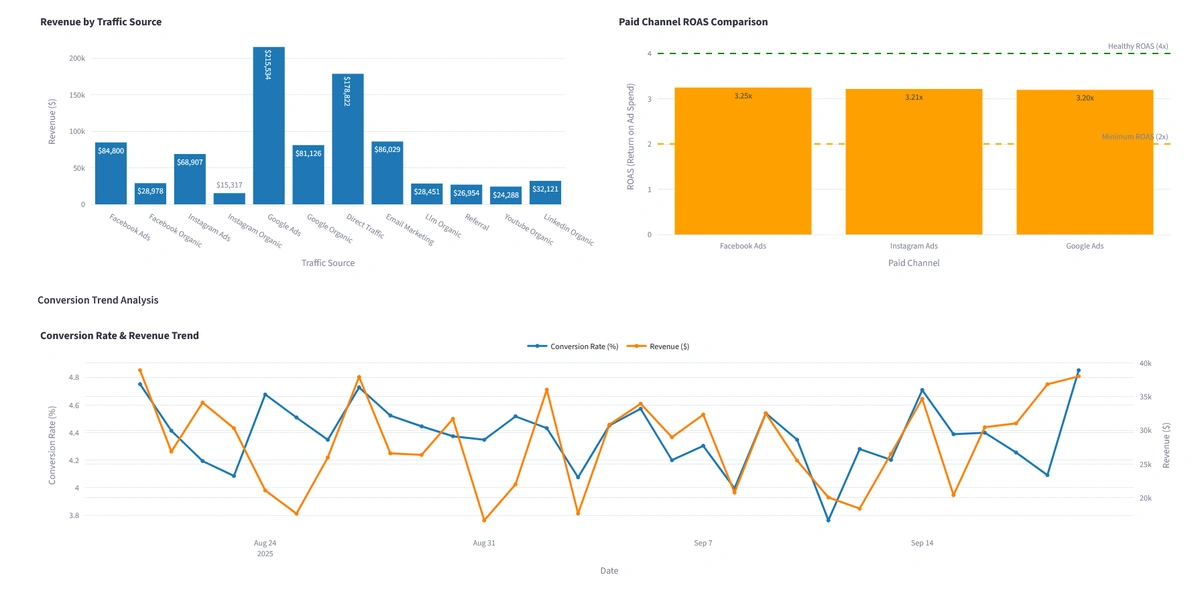
Data without visuals is noise. In the video, we had:
- Revenue by Traffic Source Pie Chart: Shows distribution; e.g., Google Ads 40%, direct 25%. Use this to reallocate budget.
- ROAS Bar Graphs: Per paid channel. Spot underperformers quickly.
- Conversion Rate to Revenue Line Graph: Over time (e.g., 30 days). Look for correlations; did a campaign spike conversions?
Then, the underrated part: Budget vs. Actual Spend.
This pulls in everything; ad budgets, tool costs (CRM like HubSpot, email like SendGrid), even headcount if marketing-heavy. Track monthly/quarterly:
- Budget Efficiency: Spent vs. allocated (aim 90-110% to avoid underspend).
- Quarterly Revenue: Tied to spend for ROI calc.
Add an “Insights” section: Jot notes like “Q2 revenue bump from retargeting campaign; scaled 2x.” This turns data into stories for team alignment.
Tools for this: Looker Studio (free), Tableau (robust), or agency dashboards like ours at lilAgents that integrate AI for predictive insights.
Going Deeper: Best Practices for Measurement That Drive Real Results
Alright, this is where we’ll expand big time beyond the video. Measurement isn’t passive; it’s an active process that informs every decision. Here’s our in-depth guide, drawn from years of trial and error.
1. Build a Robust Tracking Foundation
- End-to-End Attribution: As mentioned, last-click sucks for complex funnels. Use multi-touch models: Linear (equal credit), time-decay (more to recent touches), or position-based (40% first/last, 20% middle). Test in Google Analytics 4 (GA4); it’s free and powerful.
- Pixel and Tag Management: Install Facebook Pixel, Google Tag Manager. Track events like add-to-cart, not just page views.
- UTM Tagging: For every link. Example: utm_source=facebook&utm_medium=cpc&utm_campaign=lookalikes. This segments traffic accurately.
- Privacy Compliance: With iOS14+ and cookie deprecation, use server-side tracking (e.g., via Google Cloud) to bypass blockers. Tools like Stape or Elevar help.
Common pitfall: Data silos. Integrate everything; use Zapier or native APIs to pipe data into one dashboard.
2. Experimentation and A/B Testing: The Engine of Optimization
In the video, we touched on testing; let’s go granular.
-
The Two-Week Rule: Launch new (ad, email, post) for 14 days to gather baseline data. Why two weeks? Enough for statistical significance without dragging.
-
A/B Testing Framework:
- Hypothesis First: “Changing subject line from ‘Sale Alert’ to ‘Unlock 20% Off Now’ will boost opens by 15%.”
- One Variable at a Time: Test headline, image, CTA, timing; isolated.
- Sample Size: Use calculators (e.g., Optimizely’s) to ensure validity. Aim for 80% confidence.
- Tools: Google Optimize (free, sunsetting soon; switch to VWO), Facebook’s built-in splits, or email platforms’ A/B features.
-
Multivariate Testing: Once basics are nailed, test combos (e.g., headline + image). Requires more traffic.
-
Iteration Cycle: Winner becomes control; test again. Always have 10-20% budget for experiments.
Example: For organic blog posts, A/B headlines via tools like Thrive Headline Optimizer. Track not just traffic, but time-on-page and conversion to lead.
3. Advanced Metrics and Analysis Techniques
- Customer Lifetime Value (LTV): Revenue per customer over time. Formula: AOV x purchase frequency x lifespan. Compare to CPA; if LTV > 3x CPA, you’re golden.
- Churn Rate: For subscriptions; monthly lost customers. Tie to marketing: High churn from paid? Bad targeting.
- Marketing Efficiency Ratio (MER): Total revenue / total marketing spend. Simpler than ROAS for holistic view.
- Predictive Analytics: Use AI (like in GA4) to forecast trends. Spot anomalies; e.g., sudden CPA spike from ad policy change.
- Segmentation: Break data by demographics, device, geography. Mobile users convert lower? Optimize for that.
4. Tools and Tech Stack Recommendations
No one-tool-fits-all, but start simple: Google Analytics and Looker Studio. They’re free to start.
Budget tip: Allocate 10-15% of marketing spend to tools. ROI? Massive; better data means smarter decisions.
5. Common Mistakes and How to Avoid Them
- Over-Reliance on Vanity Metrics: Impressions? Useless alone. Always ask: Does this drive revenue?
- Ignoring External Factors: Seasonality, economic shifts; use benchmarks to normalize.
- Data Overload: Start with 5-10 KPIs; expand as you mature.
- No Actionable Insights: Data without decisions is waste. Weekly reviews: What worked? Scale/kill/tweak.
6. Scaling Measurement as You Grow
For small teams: Manual Excel pulls.
Mid-size: Automated dashboards. Enterprise: AI-driven predictive modeling.
Always audit quarterly: Is tracking accurate? Tools updated?
Wrapping It Up: Why This Matters for Your Business
If you’ve made it this far, you’re ahead of 90% of marketers. The point? Measurement isn’t about looking at pretty visuals; it’s about proving value, justifying spend, and guiding strategy. A solid dashboard like the one we described turns guesswork into growth. It shows where to double down (like that killer retargeting campaign) and what to ditch (underperforming interests).
If you’re struggling with this, whether building from scratch or optimizing existing efforts, think about how a partner like lilAgents can help accelerate. We’re built on lean, experienced foundations, blending human insight with AI to make this stuff seamless. You can start small: Grab that two-week test template we mentioned earlier, build a basic dashboard, and iterate. Explore our services to see how we can help you build a measurement system that drives real results.
Want marketing that runs through your own accounts, not ours? See how we work.
Explore marketing servicesFrequently Asked Questions
How Do You Calculate Marketing ROI?
The standard formula for calculating marketing ROI is (Revenue from Marketing - Cost of Marketing) / Cost of Marketing x 100, which gives you a percentage that represents your return relative to what you spent. If a campaign costs $10,000 and generates $50,000 in revenue, for example, your ROI would be 400%. It’s important to include indirect costs like staff time and tool subscriptions to get an accurate picture, and you should also factor in the long-term value of repeat customers or subscriptions when the numbers allow for it.
What Is the Formula for Marketing ROI?
The core formula is straightforward: subtract your total marketing costs from the revenue those efforts generated, divide by the total marketing costs, and multiply by 100 to express it as a percentage. Some businesses prefer to use a ratio format like 5:1 instead, which means five dollars earned for every dollar spent. Whichever format you choose, the key is consistency so you can compare performance across campaigns, channels, and time periods without getting confused by mixed metrics.
What Is a Good Marketing ROI Percentage?
Most industries consider a 4:1 ratio (or 400%) to be a strong marketing ROI, though the benchmark varies depending on your business model and the channels you use. E-commerce businesses with direct purchase tracking often aim for 5:1 or higher, while B2B companies with longer sales cycles may find 3:1 perfectly acceptable given the larger deal sizes involved. The most useful comparison is against your own historical data, since external benchmarks only tell part of the story and your margins, customer lifetime value, and growth stage all play a role.
How Do You Measure Digital Marketing ROI?
Measuring digital marketing ROI starts with proper tracking infrastructure, including UTM parameters on every link, conversion pixels on your site, and an analytics platform like Google Analytics 4 that can tie user journeys together from first touch to final purchase. From there, you compare revenue attributed to each digital channel against what you spent on that channel, broken out by paid search, social ads, email, organic traffic, and any other sources you’re investing in. Multi-touch attribution models give you a more complete picture than last-click, because they account for the awareness and consideration steps that happen before someone actually converts.
How Often Should You Measure Marketing ROI?
For most businesses, reviewing marketing ROI on a monthly basis gives you enough data to spot trends without reacting too quickly to normal fluctuations. Weekly check-ins on key leading indicators like cost per acquisition and conversion rates can help you catch problems early, while quarterly deep dives are the right cadence for evaluating broader strategy shifts and reallocating budgets across channels. The important thing is to build a consistent review rhythm that your team actually sticks to, because even the best measurement system is useless if nobody looks at the data regularly enough to act on it.